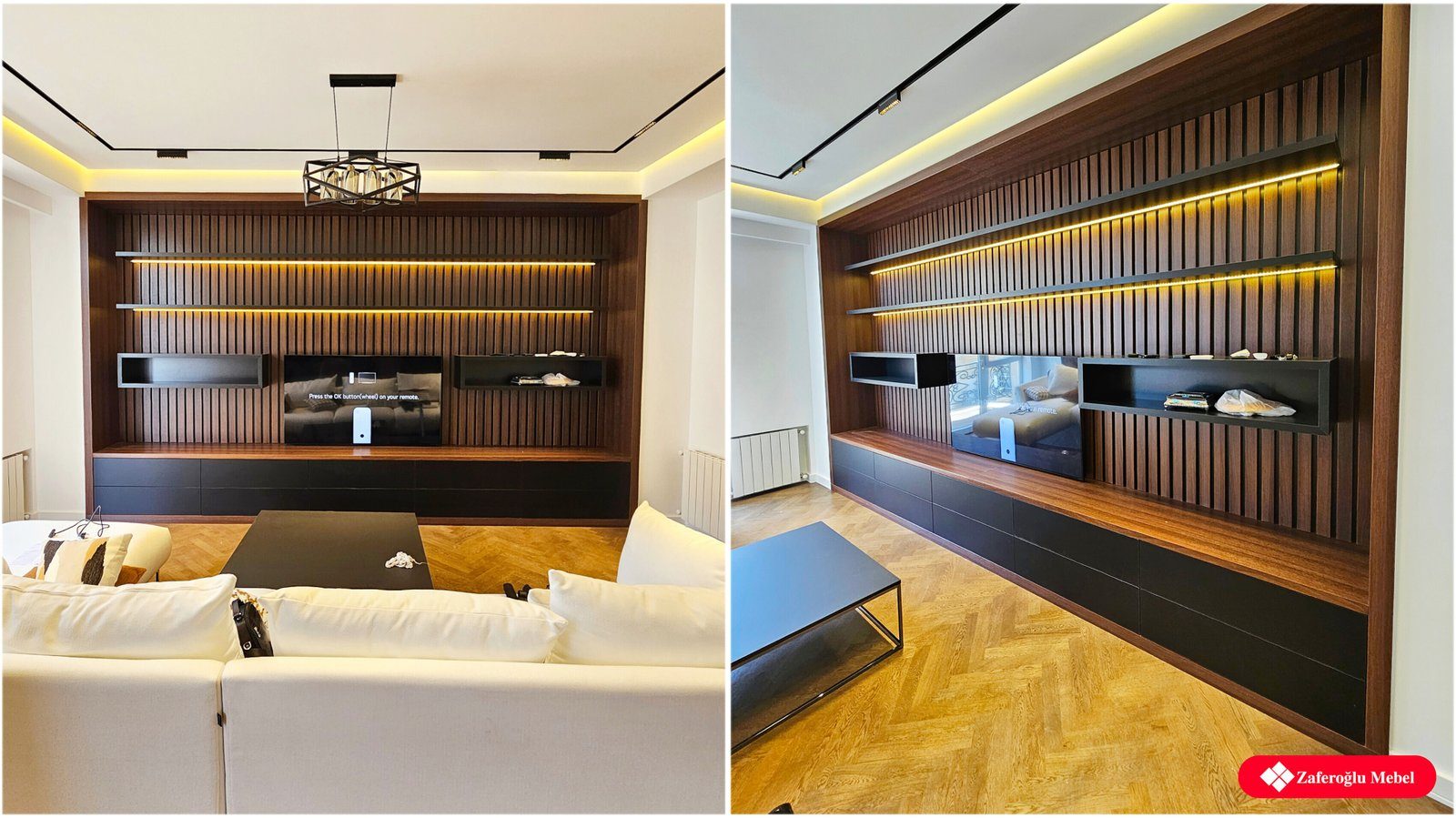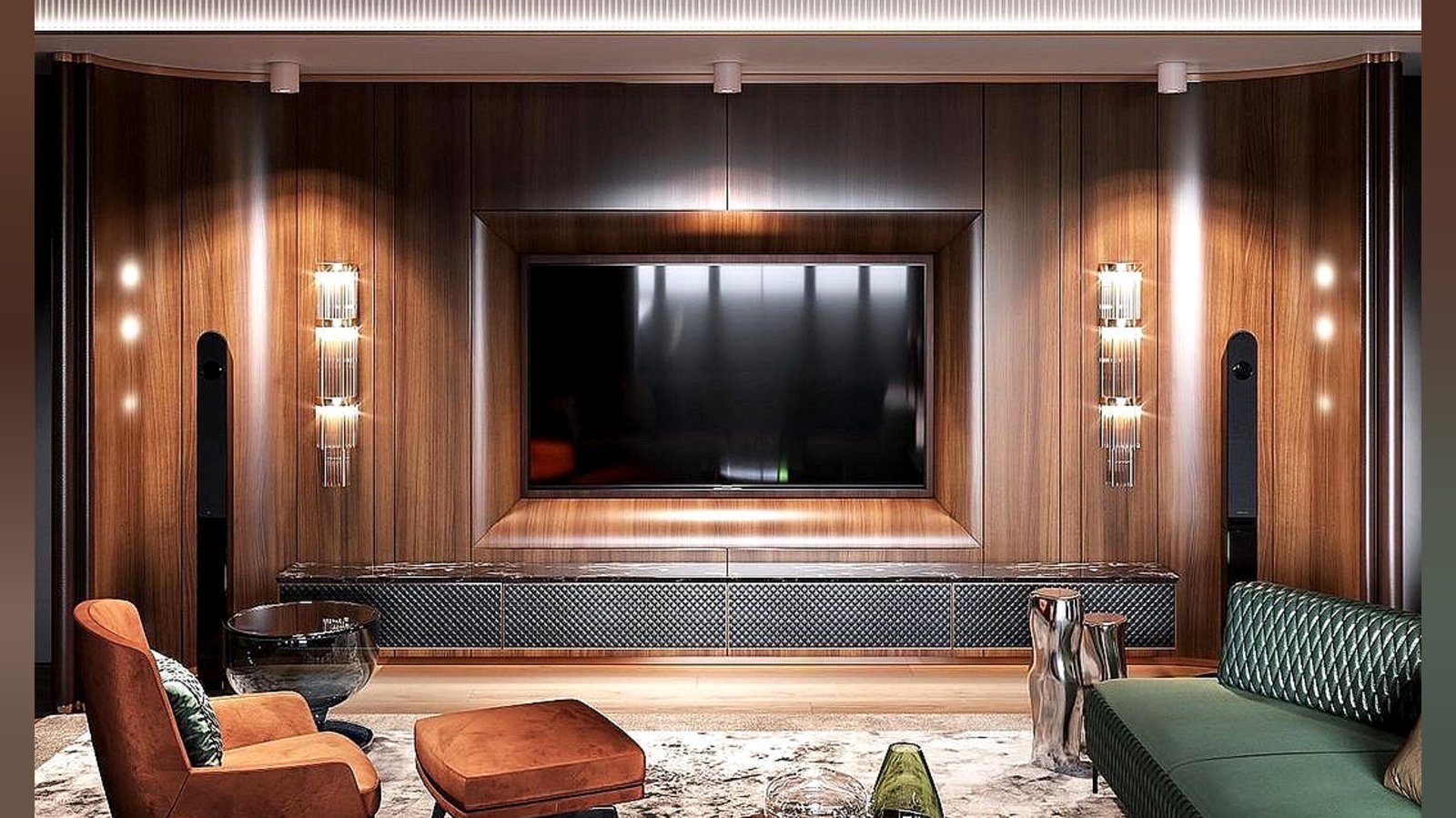

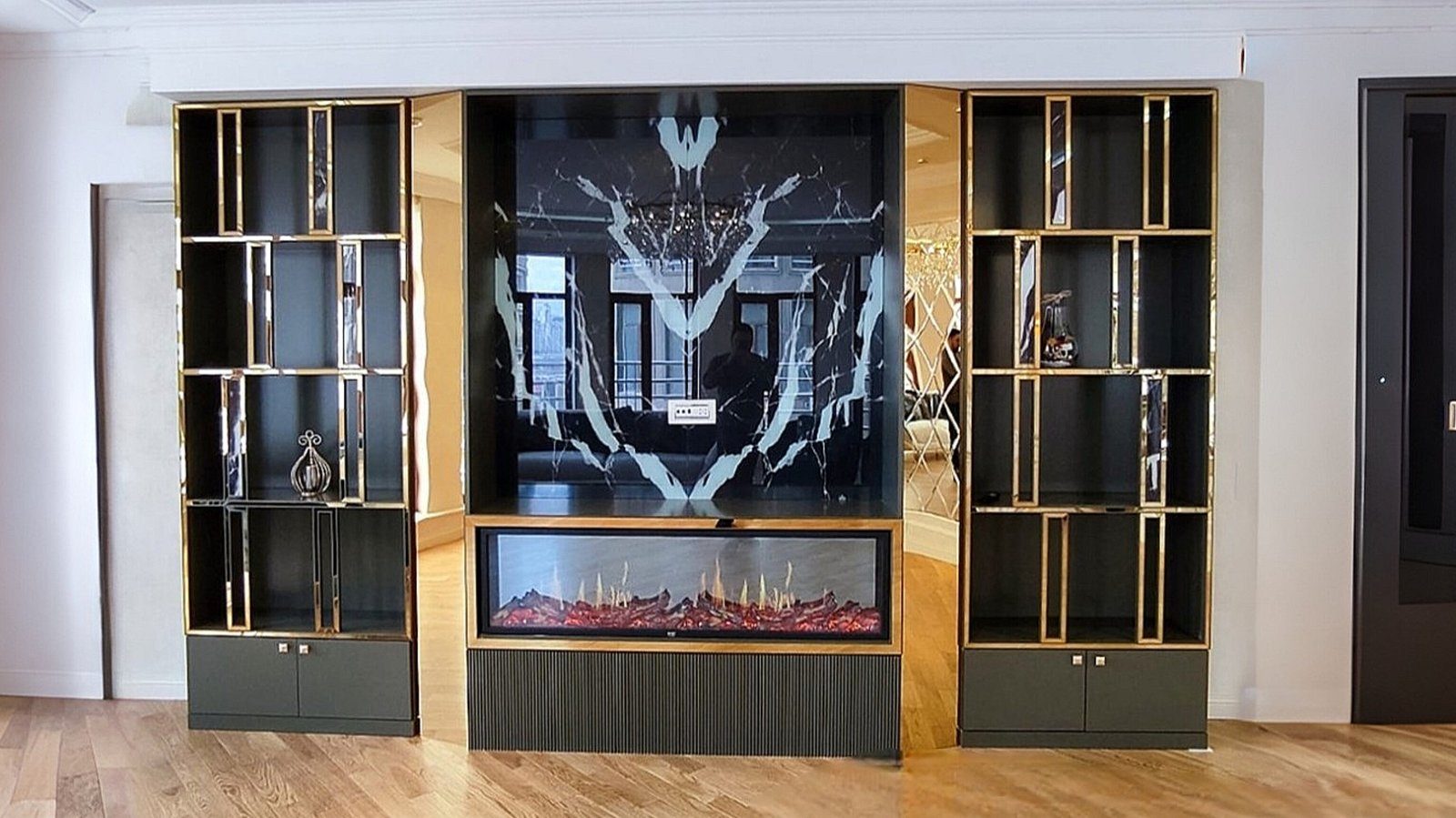
The TV area often becomes the centre of a living room, and how it is handled shapes the whole interior. There are two main approaches: a media wall that fills an entire wall and combines the television, shelves, cupboards and lighting into one composition, or a compact low stand beneath the screen. Both are sensible choices, but they answer different needs. Let us look at the key criteria one by one.
Storage needs
The main advantage of a media wall is storage capacity. Closed cupboards, open shelves, drawers and display cabinets bring books, documents, games, tableware and decorative objects together in one place. If the home has no separate storage room, or the living room doubles as a work, play and library space, that capacity is very useful.
A low stand only has room for equipment and a few items. If storage is already well handled elsewhere in the home, in wardrobes, the hallway or the kitchen, the living room does not need a large mass of furniture. A stand then keeps the room emptier and calmer.
Visual weight and room size
A media wall completely fills one wall. In a large living room with a high ceiling, this structures the space and creates a focal point. In a small room, a dark wall of units rising to the ceiling can feel oppressive. Here light colours, fronts in the same tone as the wall and a balance of closed and open elements are important: when everything is closed the mass feels heavy, and when everything is open the result is visual clutter.
A low stand leaves the upper part of the wall empty, which makes the ceiling appear higher. The wall itself remains free for a decorative element, such as a painting, wall panelling or textured plaster. In rooms with many windows or short walls, a stand is usually the only realistic option.
Cables and equipment
Cables are easier to hide in a media wall. A panel behind the television with a cable channel inside, a ventilated niche for equipment and built-in sockets can all be part of the furniture's construction. No loose cables show on the wall. But this requires planning to begin during the renovation: sockets and data cables must be positioned to suit the furniture design.
With a low stand and a wall-mounted TV, cables from the screen down to the stand run either inside the wall or through a decorative channel. If the television sits on the stand, the problem is smaller, but a bundle of cables may be visible behind it. In both cases, ventilation for equipment must not be forgotten.
Flexibility and future changes
A media wall is designed around a particular television size. A few years later, a bigger screen may not fit the niche. So it is wise to allow some spare room for the television or to mount it on an open panel rather than in a closed recess. Rearranging the room is also practically impossible with a media wall.
A low stand is more flexible in this respect. It is easy to move to another wall, take to a new home or use with a larger screen. A wall-hung stand keeps the floor clear and makes cleaning easier.
In-between options
There are many combinations between a full wall and a single stand. For example, a long low stand with a tall cabinet on one side or a few floating shelves on the wall, or a stand with a decorative wall panel behind the television. Asymmetric compositions like these strike a balance between storage and lightness.
Lighting also affects the choice. Concealed lighting inside the shelves of a media wall or behind the screen reduces eye strain when watching in the evening and adds depth to the composition. With a stand, a wall light or an LED strip under the unit can play that role. In both cases, plan the light source position in advance so it does not reflect on the screen.
Questions to help you choose
- What needs to be stored in the living room, and is there storage elsewhere in the home?
- Do the room size and ceiling height allow a large composition?
- Is renovation still under way, and can socket positions be changed?
- Is a new television or a move planned in the next few years?
- Does the style of the room call for something monolithic or something light and airy?
Zaferoglu Mebel designs media walls and low TV units to order, so the size of the composition and the mix of open and closed sections can be settled from the room's actual measurements.