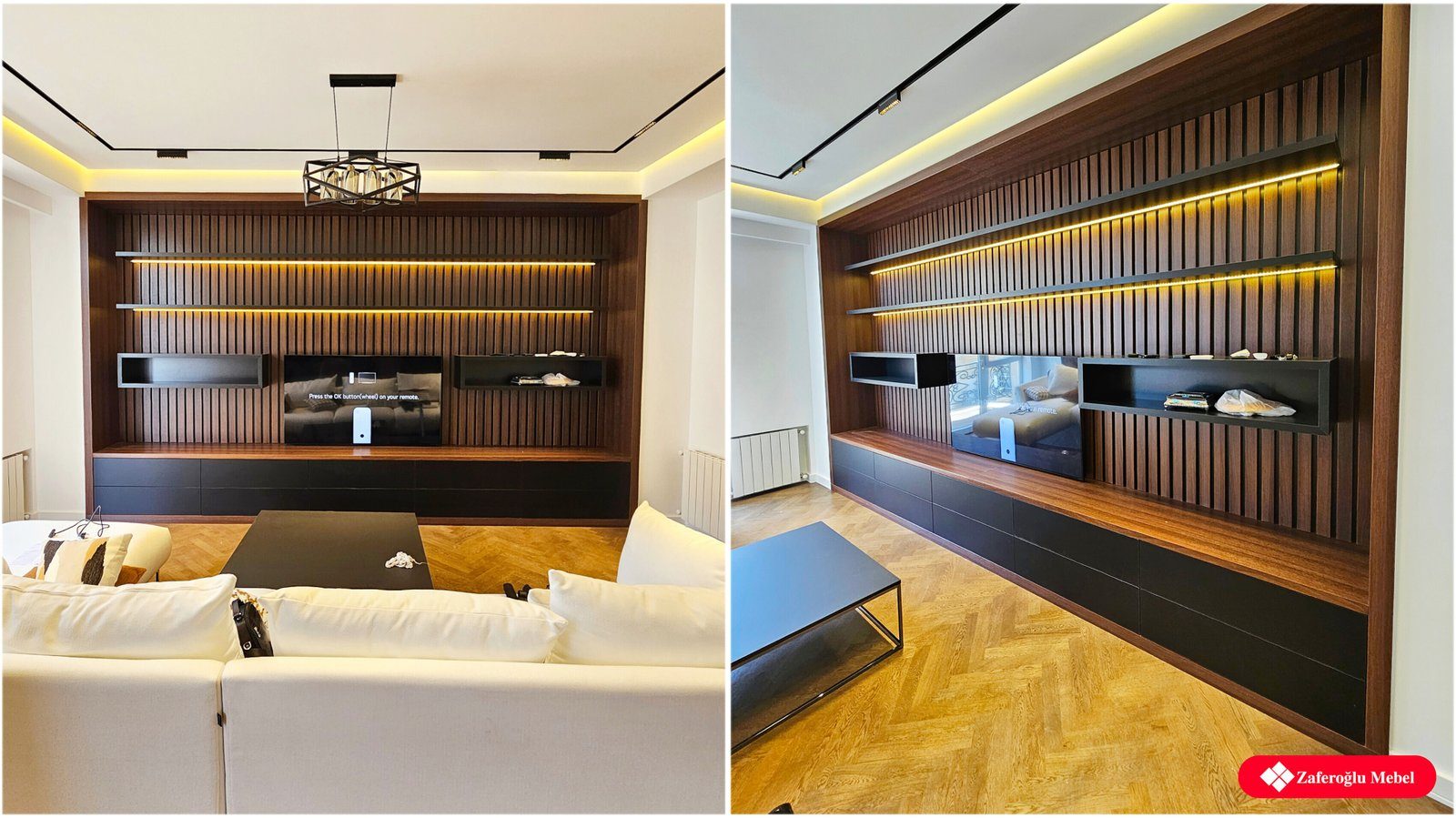


Books look light, but a full shelf carries a considerable weight. A row of books, especially albums, encyclopaedias and hardbacks, presses on the same spot for years. The result is that after a few months or years the middle of the shelf dips, books lean towards each other and the furniture looks untidy. The problem can be prevented by choosing dimensions and materials according to a few simple rules.
Why shelves sag
Three main factors affect sagging: shelf span, material thickness and stiffness, and the load it carries. The relationship is not linear. As span increases, sagging grows many times faster, which is why a short shelf made from the same board stays straight for years while a long one soon droops.
Long-term loading matters too. Board materials under constant load creep over time, so a shelf that looks straight on day one may slowly bend. Shelves should therefore be planned on the assumption that they will stay full for years, not on how they look at first.
Span and material
The most reliable approach for bookshelves is to keep spans short. If shelving runs along a long wall, it is divided into several narrow sections by vertical partitions. Each shelf is then short and less likely to sag. This vertical rhythm also gives the bookcase a neat, architectural look.
Material choice affects the result:
- Laminated chipboard suits short shelves but is more prone to sagging over long spans.
- MDF is denser but heavy, and it also sags over long spans.
- Plywood and solid wood resist bending better thanks to their fibre structure.
- Thicker board, or two layers glued together, reduces sagging considerably.
A metal profile or timber lipping fixed along the front edge also adds stiffness and makes the shelf look more substantial.
Supports and fixing
How a shelf is supported determines its durability. Adjustable shelves resting only on small metal pins carry their load at four points. On bookshelves, fixing the back edge to the back panel or wall, or joining the shelf rigidly to the side panels, reduces sagging.
A back panel is not just decorative. A thin back stops the cabinet racking, and a thick, fixed back gives extra support to the rear edge of the shelves. In open-backed shelving, wall fixing does this job.
A tall bookcase must be fixed to the wall. A tall case full of books has a high centre of gravity and can topple if a child climbs it or a heavy book is pulled out.
Shelf spacing and depth
The height between shelves depends on book sizes. Ordinary novels and paperbacks fit in low sections, while albums and large-format books need taller ones. Rather than making all shelves the same height, it is more practical to plan taller sections at the bottom and lower ones at the top: heavy large books sit low, and the bookcase's centre of gravity drops.
Shelf depth should suit the books too. On very deep shelves, books end up in two rows and those at the back are forgotten, or a dusty empty strip is left in front. Adjustable shelves allow rearranging as the collection changes.
Mixed use: books, decor and electronics
In a living room, bookshelves often hold more than books: vases, photos, a sound system or games console. That adds requirements. Sections for electronics need ventilation and cable outlets. Closed cabinets below hide clutter, while open shelves above display the collection.
Instead of lining up all books side by side, alternating some sections with horizontal stacks, decor and empty space makes shelving look lighter. It also helps spread heavy loads more evenly.
Care and checks
It is worth checking bookshelves from time to time: has sagging started in the middle, are supports in place, has the unit pulled away from the wall? Turning over a shelf that shows sagging, or adding a support beneath it, stops the problem getting worse. Keeping books out of direct sunlight protects both bindings and furniture surfaces from fading.
Zaferoglu Mebel makes living room furniture and bookcases to individual measurements. Shelf spans, the number of sections and materials can be calculated together based on the size of the book collection.