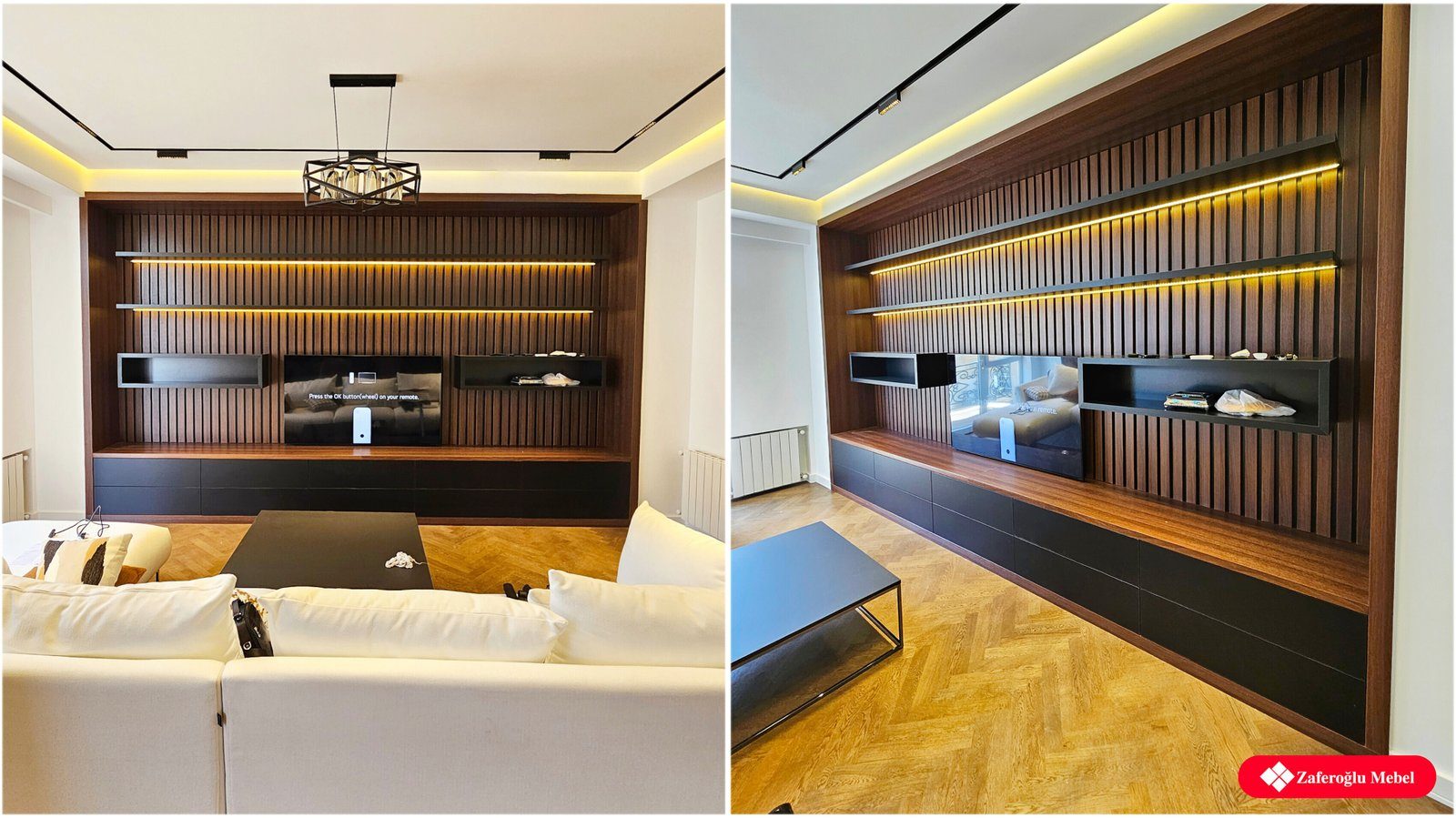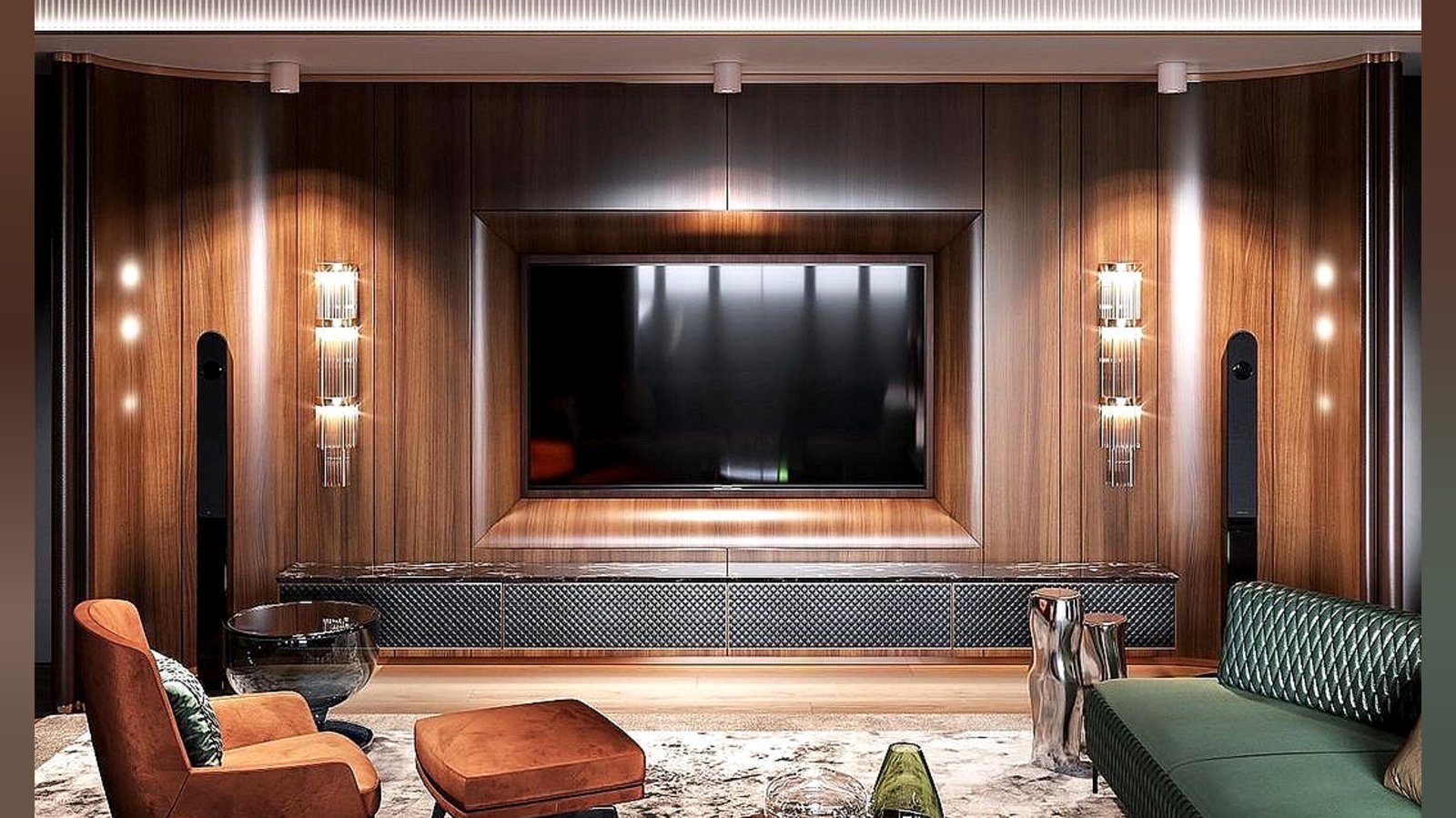

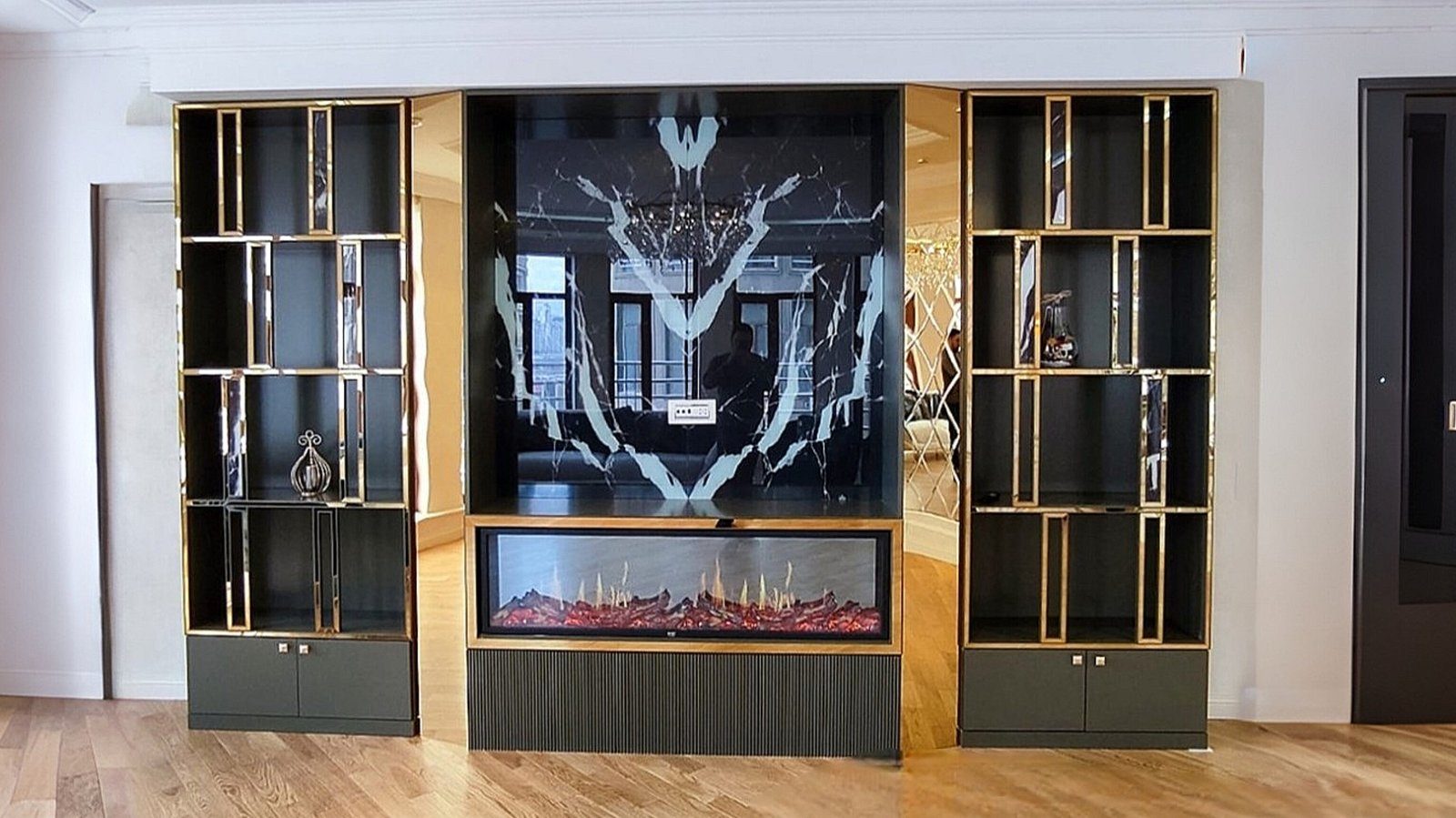
A floating TV unit makes a living room look tidier and larger: the floor stays visible, cleaning is easier and a robot vacuum can pass underneath. But furniture with no legs puts its whole load — its own weight, the equipment inside, discs, decor and the pressure of someone leaning on it — onto a handful of fixing points. Whether the unit stays level for years depends on how those points are anchored.
Start by knowing the wall
The same unit needs very different fixings on different walls, so find out what the wall is made of before installation:
- Solid concrete and solid brick are the most reliable base. Standard expansion plugs and anchors of a suitable length hold the load well.
- In hollow brick and hollow blocks an ordinary plug can end up in a void and spin. Chemical anchors that fill the cavities, or long plugs designed for perforated materials, are used instead.
- Aerated concrete is soft and porous. It calls for helical plugs made for it or chemical anchors; a regular plastic plug gradually loosens under load.
- A plasterboard partition cannot carry a heavy unit on its own. Fixings go into the metal studs or into timber backing installed in advance, or the load is taken through to the structural wall behind.
If the wall type is unknown, a test hole in a hidden spot — watching the colour of the dust and how the drill behaves — is the simplest check. Cables and pipes running inside the wall must also be located before hole positions are chosen.
Estimating the load properly
A unit's weight is more than its panels. The estimate should include:
- Equipment inside: receiver, games console, router, amplifier.
- Items in the drawers and whatever sits on top — decor, books, speakers.
- Dynamic loads: a child sitting on it, a drawer yanked open, someone leaning on it while cleaning.
On a long unit, weight concentrated in the middle can cause sagging. Fixing points are therefore spread along the full length rather than placed only at the ends, and internal partitions add stiffness to the carcass.
Hanging the television on its own wall bracket rather than standing it on the unit is the better approach. The screen's weight then never reaches the furniture, and the unit only has to do its own job.
Hidden hanging systems
For the unit to appear to float, the fixings must stay out of sight. There are several ways to achieve that:
- A metal hanging rail on the wall with a matching part on the back of the carcass: the unit hooks on and is then levelled.
- Two interlocking bevelled strips of timber or metal (a French cleat), which spread the load along the whole length.
- Anchors driven straight into the wall through a reinforced strip inside the carcass.
- Adjustable cabinet hangers, which allow the height and tilt to be fine-tuned after mounting.
If the back panel is thin board, it must not carry the load. Fixings always go through the thick parts of the carcass or through a solid rail built in for the purpose.
Height, cables and ventilation
The mounting height is chosen from the eye level of someone sitting on the sofa and the position of the TV. The gap between the underside and the floor should be comfortable for cleaning without reading as an awkward strip, and it also affects the visual balance of the room.
Without planning, dangling cables ruin the whole floating effect. Sockets and aerial outlets should sit behind the unit, inside the carcass, with cable openings cut in the back panel. Compartments holding equipment need a gap at the back or bottom so warm air can escape; a device running in a closed, airtight section overheats.
Common mistakes
Most problems with floating units come not from the furniture itself but from installation decisions:
- Using the generic plastic plugs supplied in the box without regard to the wall type.
- Putting the entire load on two end points and leaving the middle of a long unit unsupported.
- Hanging the unit while wall finishing is still under way.
- Placing the socket directly behind the unit where it cannot be reached.
- Forgetting that a bigger sound system or extra devices may be added later.
Each of these can be avoided with a few minutes of discussion before installation, whereas fixing them afterwards often means taking the unit down again.
Checklist after installation
- The unit is level and its front edge does not tip forward.
- Drawers and doors close with even gaps.
- Pressing gently down on the top does not make the carcass move.
- Cables are not pinched and the equipment section has airflow.
Zaferoglu Mebel makes TV units and media walls to individual measurements and installs ordered furniture with its own fitters free of charge. The wall type and fixing method can be checked on site when measurements are taken.