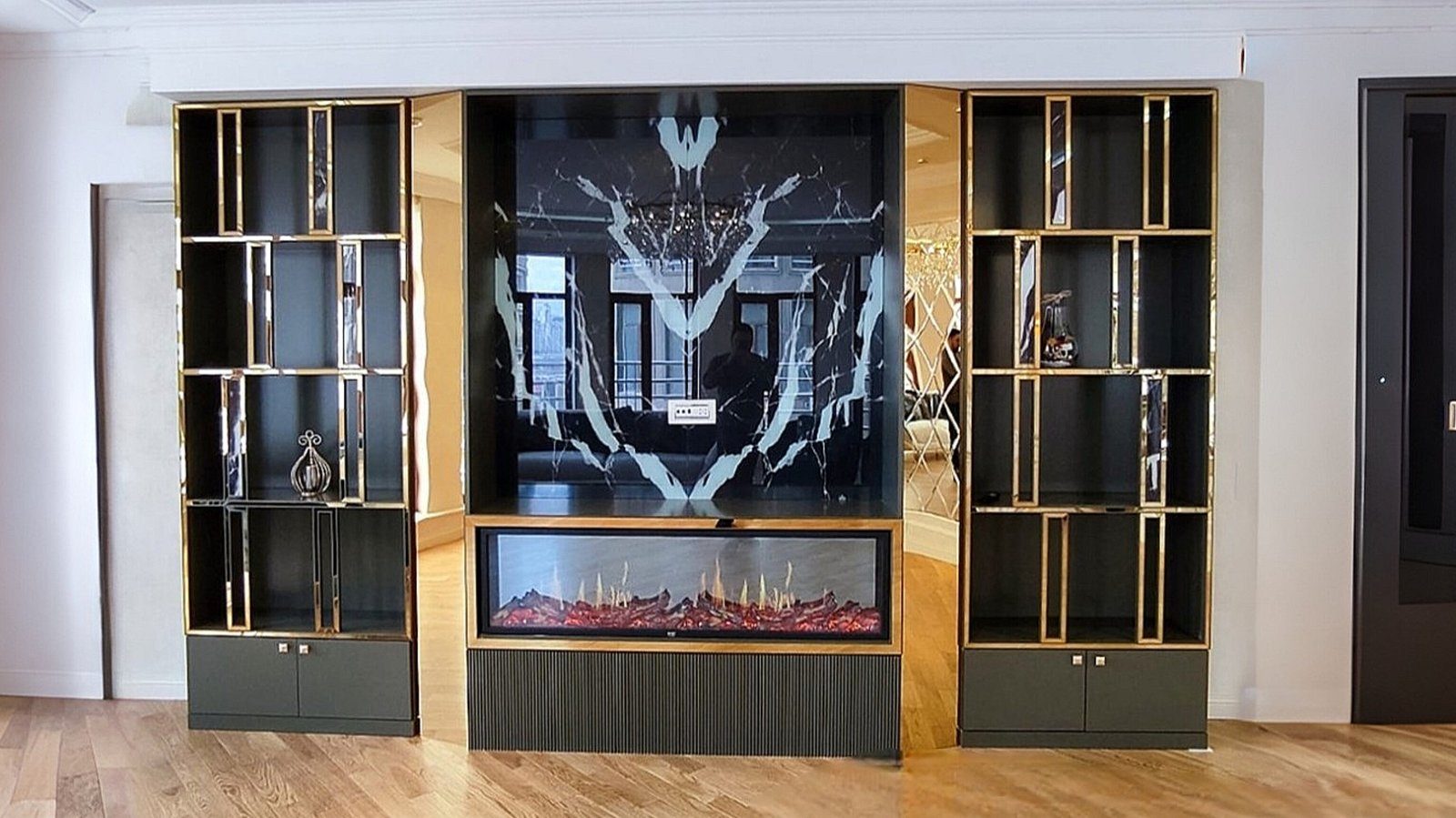

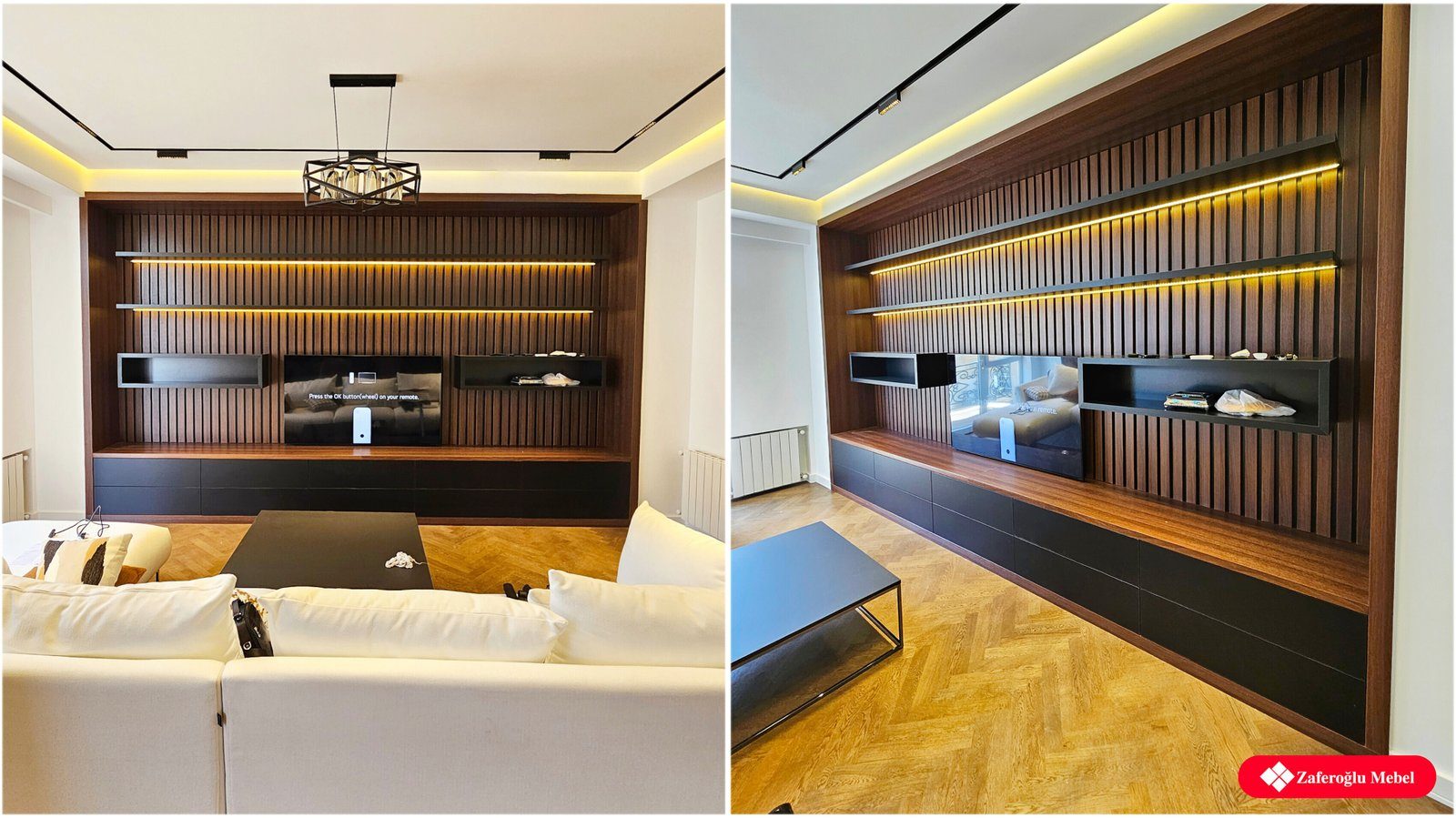
Books tend to scatter around a home: some on a TV unit shelf, some in the bedroom, the rest in boxes. A floor-to-ceiling shelving system brings them together and turns a wall into the room's main feature. But books are a heavy load, and a solution that works for decorative shelves can quickly sag in a library. This piece of furniture should be planned as a structure before it is planned as a look.
The weight of books and shelf sag
A full bookshelf is heavier than people expect, especially when albums, encyclopaedias and thick volumes stand side by side. Three things affect sag: the board material, its thickness and the distance between supports. A long unsupported shelf bends more than a short one of the same material. Sag usually develops gradually over months rather than all at once, and it is hard to correct later.
Ways to prevent it:
- Keep spans short and divide a long wall into several sections with vertical uprights.
- Use thicker boards or doubled shelves for heavy books.
- Support the back edge of the shelf on the back panel or a profile fixed to the wall.
- Put the heaviest volumes on lower shelves, close to the wall.
Making many of the shelves fixed strengthens the system. Adjustable shelves are convenient, but several fixed shelves should provide the carcass with its rigidity.
Depth and shelf spacing
Most ordinary books fit on a shallow shelf. A very deep shelf wastes space: a gap is left in front of the books and other things tend to pile up there, or books are placed two rows deep and the back row is forgotten. So the main part is planned shallow, with a deeper lower section for albums and large-format editions.
Varying the shelf spacing to suit your collection helps. Use low spacing for paperbacks, medium for standard books and tall spacing for albums and folders. Sorting your books into a few groups and measuring the height of each makes the shelf plan far more precise. Adjustable shelves in one or two sections leave room for future changes.
Wall fixing and the floor
A tall shelving system must be fixed to the wall. Even though a full bookcase is heavy, leaning on it to reach the top or a child climbing it can tip it over. Fixings are chosen for the wall type, whether concrete, brick or plasterboard; on plasterboard, heavy loads need to be fixed into the frame behind or with special anchors.
On a floor that is not quite level, adjustable feet or a plinth are essential. A slight tilt at the base becomes obvious across the full height, and shelves and doors start to look skewed. Leaving a small gap or a filler panel up at the ceiling also makes fitting easier.
Reaching the upper shelves
The highest shelves of a floor-to-ceiling bookcase are beyond everyday reach, so give them to books you rarely open, archive boxes or ornaments. Keep the titles you use often between waist and eye height.
If the top will be used regularly, there are two options. The first is a stable folding step or small stool. The second is a library ladder running on a rail fixed along the shelving. A ladder needs enough free floor space, and the rail should be planned together with the shelving so that its fixing points are solid.
Open shelves, closed cabinets and light
A fully open wall looks impressive but also brings dust and visual clutter. A balanced solution is often closed cabinets at the bottom for folders, games and papers, with open shelves above for books. The top of the lower cabinets also becomes a surface for putting books down or leafing through them.
Lighting around the library needs thought too. An LED strip inside the shelves makes spines easier to read, and space can be planned nearby for a reading lamp or armchair. Direct sunlight on a bookcase fades book covers over time, so curtains or closed doors are useful in sections near a window.
If shelving goes around a door or window, the shelf spanning the opening carries more load and needs extra support. The swing of the door leaf must not clash with the shelving either.
Zaferoğlu Mebel makes bookcases and living room furniture to individual measurements, using Egger and Kronopol boards. With the wall dimensions and an estimate of your book collection, the number of sections and shelf thickness can be decided at the design stage.