
When you buy a television, the box only states the diagonal. Furniture needs different numbers: the actual screen width, the distance between the feet, where the connections sit at the back, and of course eye level. If the unit is not chosen with these in mind, either the screen overhangs the furniture or you end up tilting your head up to watch. Here is what to look at, step by step.
Not the diagonal, the real width
The diagonal is the distance from one corner of the screen to the opposite one, given in inches. On a 16:9 set the screen width is roughly 87 percent of the diagonal. A 55-inch model is therefore about 122 cm wide and a 65-inch about 144 cm, with the bezel adding a few centimetres. The most reliable source is the manufacturer's specification sheet, which lists the dimensions of both the screen and the stand or feet.
The unit should be at least a little wider than the screen. Visually, furniture that is broader than the television makes the composition look more stable, and the screen does not seem to hang over the edges. If the wall allows, a unit noticeably wider than the screen on each side helps both the look and the storage.
Feet and support points
Many modern televisions have feet placed close to the edges of the screen. In that case, even if the unit is narrower than the screen, it must not be narrower than the distance between the feet, or the set simply will not sit on it. With a central pedestal, depth matters more: the footprint should not end up too close to the front edge.
Depth is planned for both support and the cables behind. A unit pushed tight against the wall pinches the cables or forces the television forward. Routing cables through a cut-out in the back panel or a dedicated channel solves this.
Height: screen centre near eye level
The centre of the screen is most comfortable at seated eye level or a little lower. On a typical sofa, an adult's eyes sit roughly a metre above the floor, depending on seat height. To estimate: from eye height, subtract half the screen's height to find where the bottom of the screen should be, then take off the height of the TV's stand to get an approximate unit height.
That is why low units usually suit large screens and low sofas. A taller unit makes more sense for a smaller screen or in a bedroom where you watch from the bed. If the television will be wall-mounted, the unit only provides storage and its height is more flexible, but the centre of the screen should still not sit far above eye level.
Room for equipment and airflow
List in advance what will go inside the unit: set-top box, games console, amplifier, router, discs. Note each device's dimensions and the space it needs behind it for cables. Devices that get warm should not be shut in a closed box: they need an open niche, a hole in the back panel or ventilation slots. Glass or perforated doors are also practical because remote control signals pass through.
If a soundbar will sit below the screen, it must not block the lower edge of the picture. This is a detail that is often forgotten when the unit height is worked out.
Load capacity matters as much as dimensions. Large televisions, especially older models, and powerful sound systems can be heavy. Without a support in the middle, the top of a long unit will gradually sag, and that shows even from across the room. For units much longer than a metre, plan an intermediate partition, a thicker top or a metal reinforcement. If the unit is wall-hung, the fixings are chosen for the weight of the furniture plus all the equipment that will sit on it. In homes with children, anchoring a tall freestanding unit and the television to the wall removes the risk of tipping.
A short checklist
- Screen and foot dimensions are taken from the specification sheet.
- The unit is no narrower than the foot spacing and, ideally, wider than the screen.
- Sofa seat height and screen centre have been worked out together.
- Niches and a cable route are planned, and ventilation is not forgotten.
- The soundbar's position and height are accounted for.
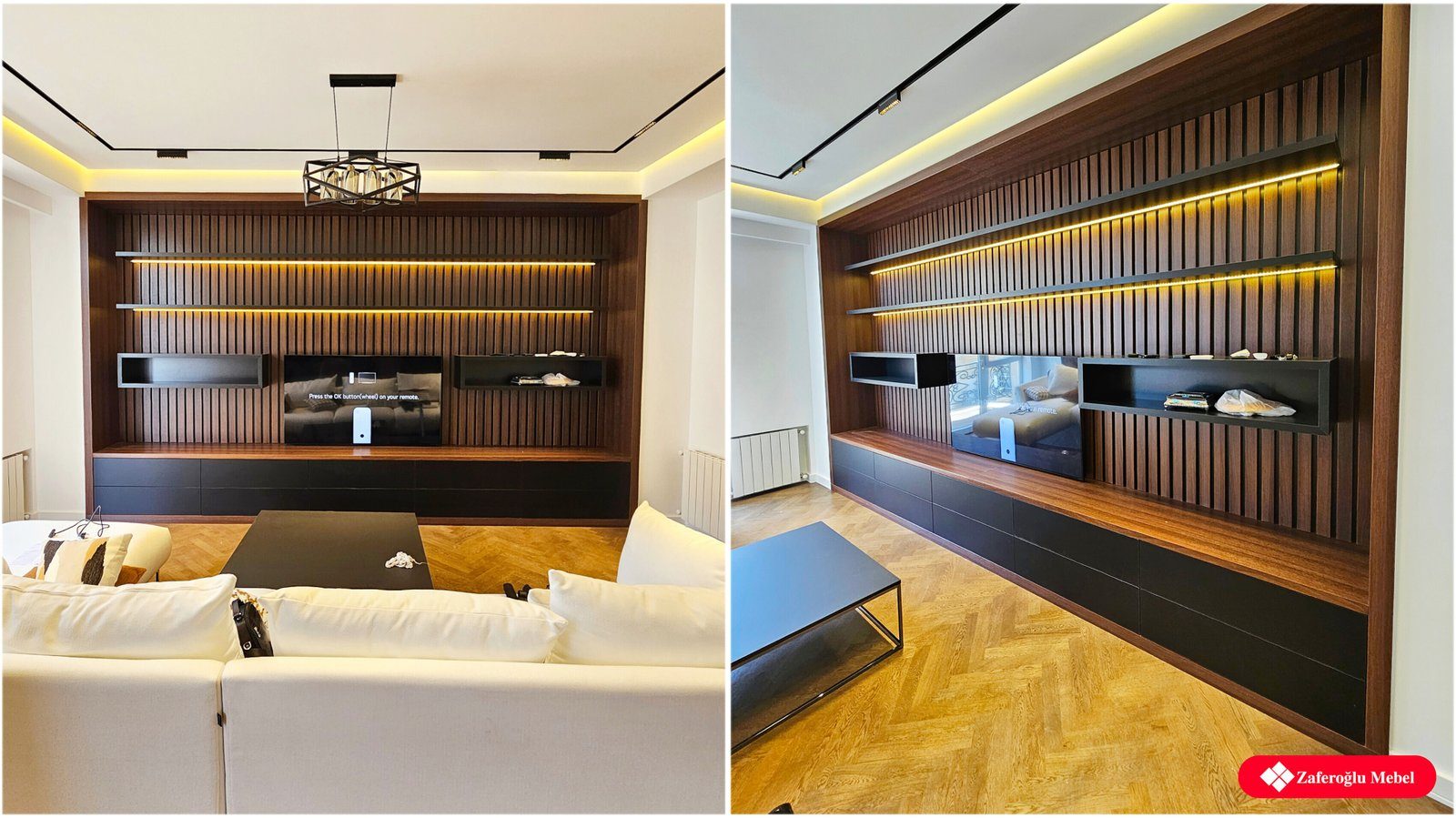
Zaferoglu Mebel makes living room TV units to individual dimensions. If the TV model and the sofa position are known beforehand, the size and internal layout of the unit can be calculated precisely when measurements are taken.