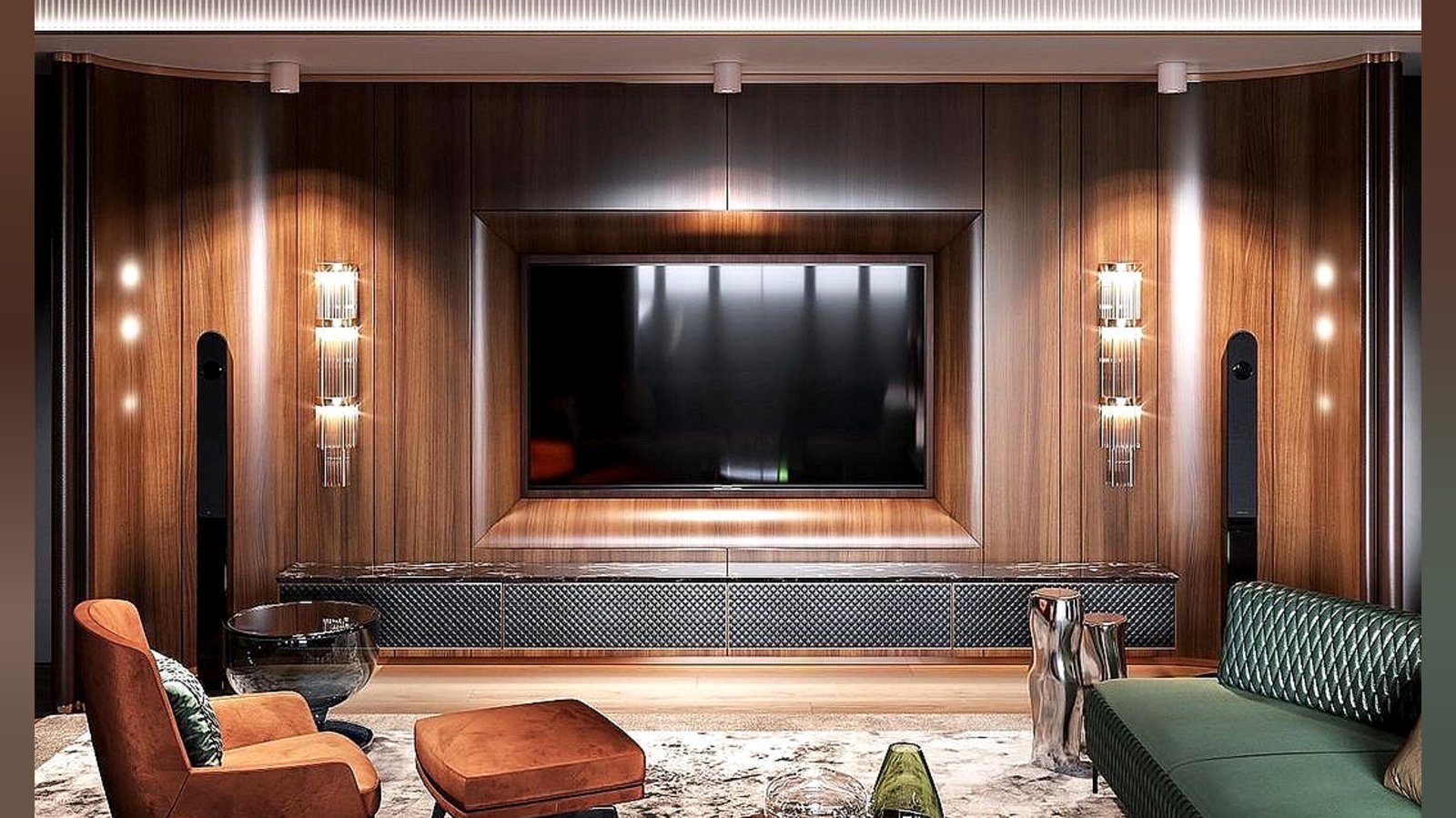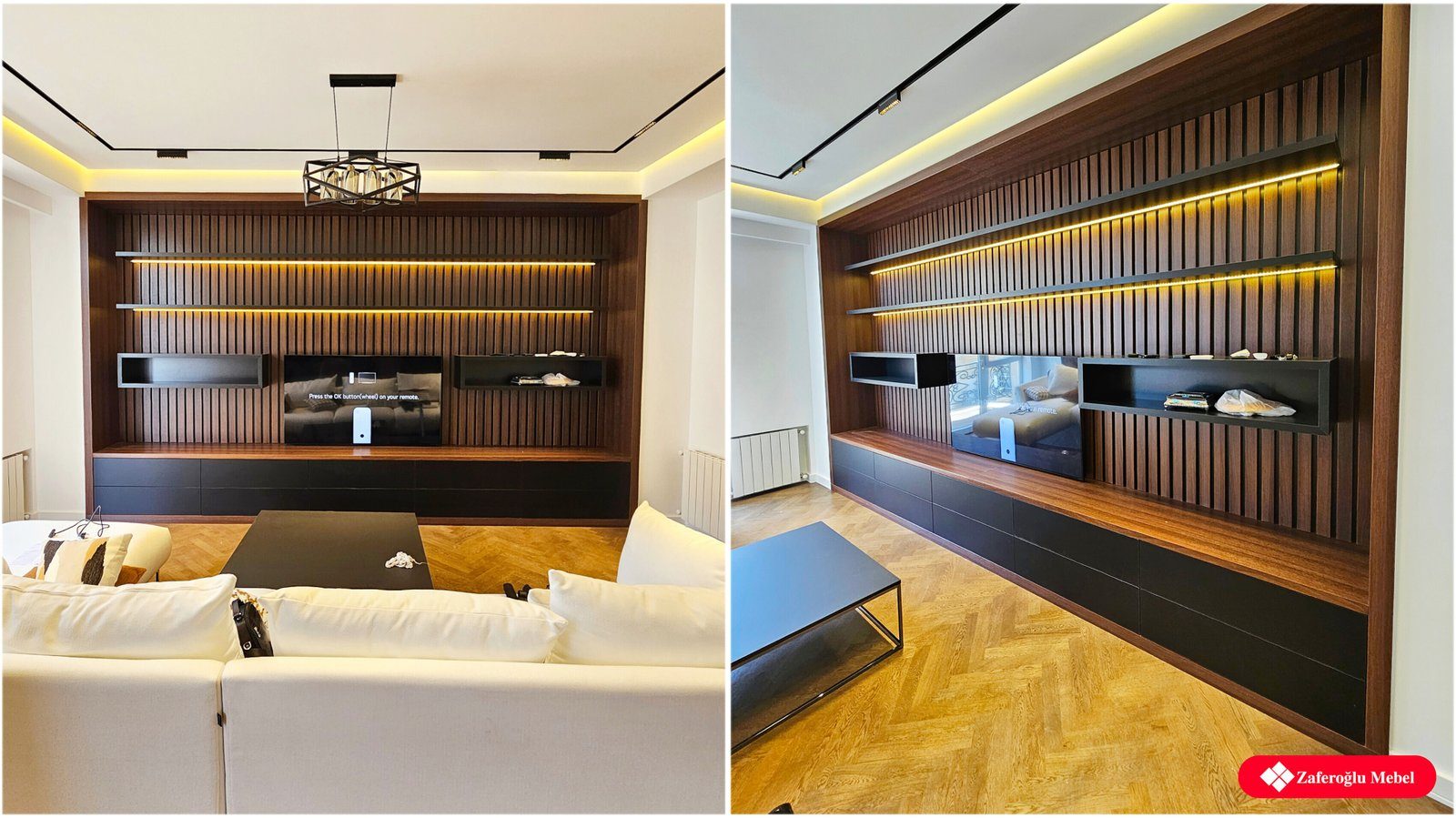

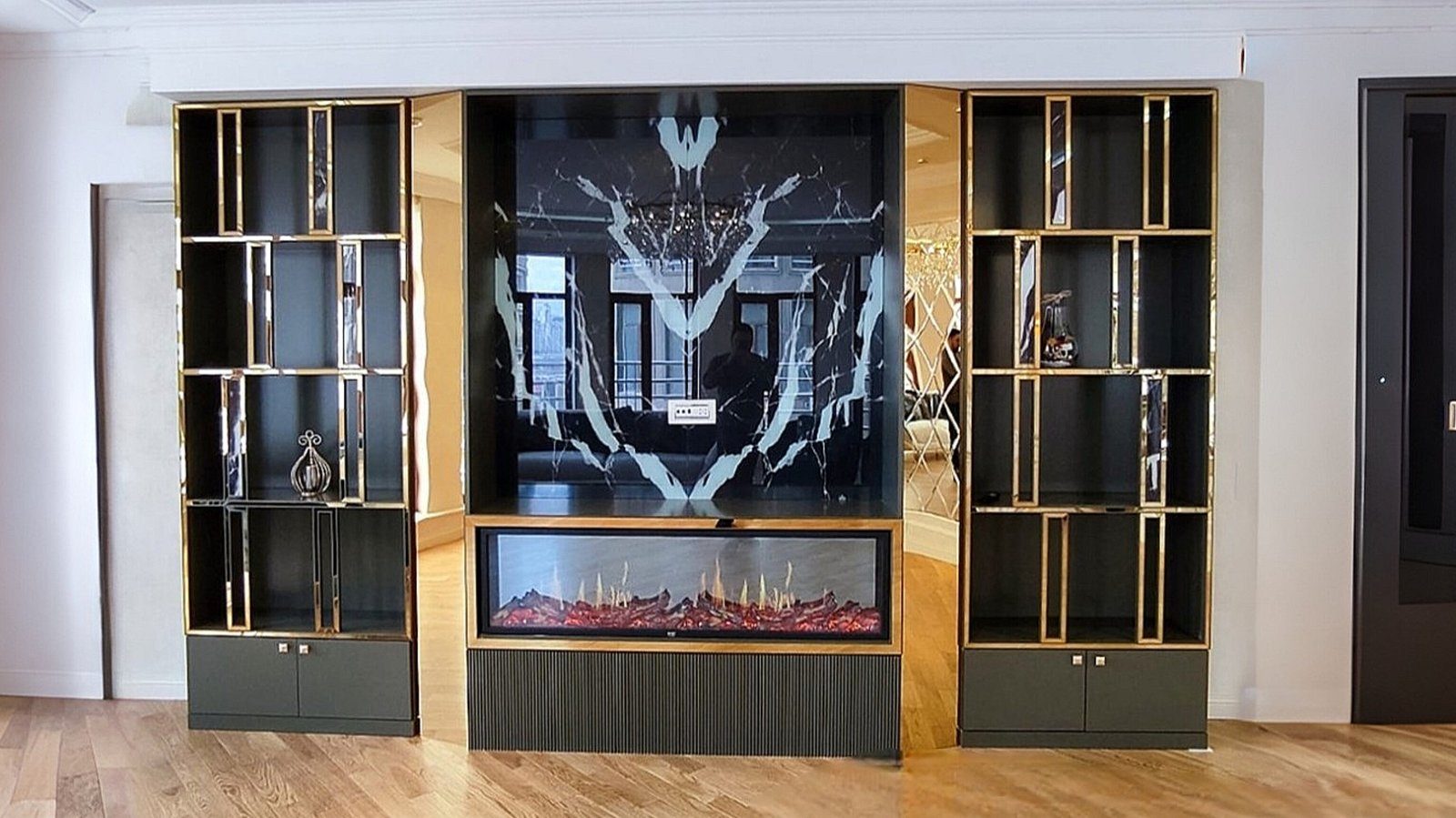
Watching TV in a dark room in the evening tires the eyes: the sharp contrast between a bright screen and a dark wall forces the pupils to keep adjusting. Switch on the ceiling light, and reflections appear on the screen. Well-planned lighting on a TV wall strikes a balance between these two problems and turns the furniture into a decorative feature at the same time. But lighting should be treated as part of the design, not a detail "added" after the furniture is made.
Background light behind the screen
Soft light falling on the wall behind the TV reduces the contrast between the screen and its surroundings. This eases eye strain during long viewing in a dark room and gives the screen a sense of depth.
There are several ways to create background lighting:
- LED tape fixed to the back of the television: easy, but the lighting belongs to the set and has to be redone when the TV changes.
- Concealed lighting behind a TV panel: if the TV is mounted on a panel of the wall unit, light spills from the edges of the panel onto the wall. This looks tidier and does not depend on the TV.
- A gap between panel and wall: when the panel is mounted slightly away from the wall, light spreads around the whole perimeter and the panel appears to float.
Background light should be much dimmer than the screen; the aim is not to light the wall but to soften the contrast.
Shelf and niche lighting
Without lighting, open shelves and niches become dark voids in the evening. LED lighting turns them into a decorative display.
- A concealed strip under the front edge of a shelf lights the shelf and objects below while the light source stays out of sight.
- A vertical strip at the top or on the side walls of a niche lights its full depth evenly.
- With glass shelves, light fed in from the edge makes the glass edge glow and the shelf look lighter.
- Small spotlights suit highlighting individual objects — a collection, a sculpture, a row of books.
The main rule is to hide the light source itself. If LED dots are visible from the seating, the effect looks cheap and causes glare.
Profiles and diffusers: the key to neat light
Sticking an LED strip directly onto board is the simplest but least durable method. An aluminium profile dissipates the strip's heat, protects it from mechanical damage and keeps it in a straight line. A matt diffuser on top of the profile turns individual points of light into a continuous, soft line — especially important near gloss fronts or polished shelves, where every point would be reflected.
The groove for the profile is routed into the board during furniture production, so the profile sits flush with the surface and cannot be seen from the side. Doing this after installation is difficult and can damage the board.
Light colour and brightness
On a TV wall, the light colour should match the room's general lighting. Warm white creates a relaxed evening mood and works well with wood textures. Neutral white shows colours more accurately and suits modern, cool-toned interiors. Mixing strips of different light colours in one room looks untidy.
Colour-changing RGB strips can be fun, but in daily use people often return to plain white. A dimmable system is more practical: lower the light for a film, raise it when guests arrive.
Controls and cables
Lighting that is awkward to control soon goes unused. When planning, decide:
- Will the lights be controlled from a wall switch, a remote or a phone?
- Will background, shelf and niche lighting be switched separately?
- Where will the power supply (driver) go? It gets warm and needs a ventilated but accessible spot — for example, a rear compartment of the TV unit.
- Which channels will cables run through between shelves?
When all these cable routes are shown on the furniture drawing, the necessary holes and channels are cut in the boards during production, and no wires are visible after installation.
Quick check
- Is soft background lighting planned behind the screen?
- Are light sources hidden from the seating?
- Will LED strips be fitted with profiles and diffusers?
- Does the light colour match the room's other lighting?
- Is the power supply in a ventilated, accessible place?
Zaferoglu Mebel makes TV stands and wall units to individual dimensions. Including lighting, profile grooves and cable channels in the furniture drawing at the design stage avoids extra holes and visible cables after installation.