
Ordering office furniture often starts with picking desks and chairs from a catalogue. The result is either not enough room or an office that is full but does not work: nowhere to meet, papers piling up on desks, noise breaking concentration. The right order is the opposite: first understand how the team works, then define the zones, and only at the end choose the actual furniture.
Describe how people work
The nature of work differs in every office. Accounting and legal teams handle documents and need quiet and privacy. Sales staff spend a lot of time on the phone, designers and developers sit for long hours in front of large monitors, and managers go in and out of meetings all day. These differences directly determine what kind of furniture is needed.
Before planning, write down simple answers for each department: how many people, how many hours a day at the desk, what equipment, how much paper, how much phone time, and whether clients are received. That table becomes the basis for every later decision.
Define the zones
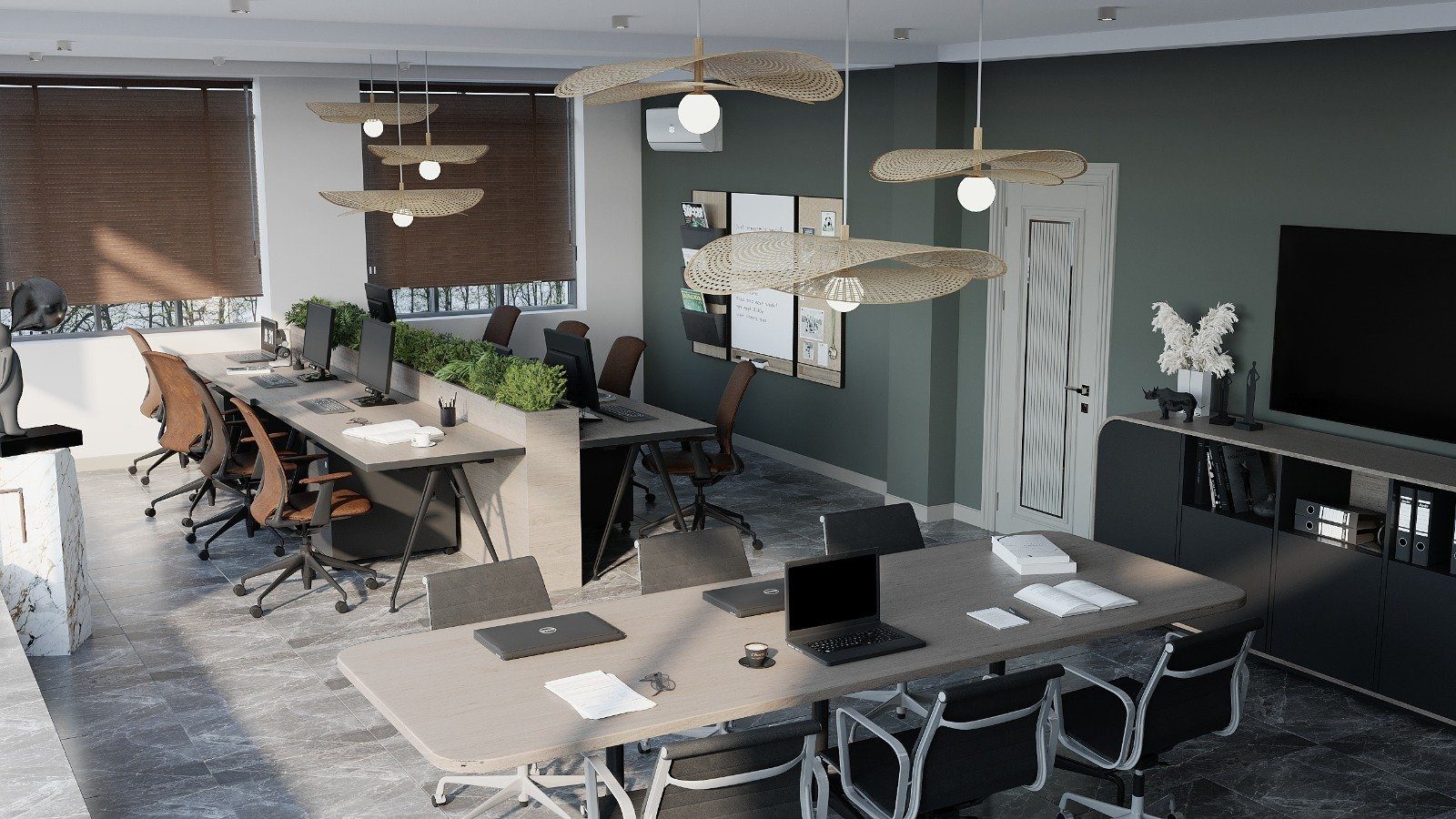
The floor area should be divided by function. A typical office has these zones:
- Workstations: individual desks or grouped benches.
- Enclosed offices: for management and work that requires privacy.
- A meeting room or a small meeting area.
- Reception: for greeting and seating visitors.
- Archive and storage: cabinets, shelving, safes.
- A kitchen or break corner.
When placing zones, think about noise and circulation. Reception should be near the entrance, and a visitor should not have to walk through every workstation. It makes sense to separate a phone-heavy team from people doing focused work, or to place storage cabinets between them, which partly absorb sound.
Walkways and safety
Packing desks tightly seems to fit more people at first, but when there is no room to push a chair back, walk behind someone or open a cabinet, comfort drops sharply. Each desk needs clear space behind it for the chair to move, and main walkways should be wide enough for two people to pass. Escape routes, electrical panels and fire equipment must never be blocked by furniture.
Window positions matter as well. A window directly behind or in front of a monitor causes eye strain; placing desks side-on to windows usually works better.
Storage and cables
Paper has declined but not disappeared. A small pedestal for personal items at each workstation and shared cabinets for each department help keep desks clear. Archive documents should be stored away from the work area, in a separate room or in locked cabinets.
Cable management is the most often forgotten part of office furniture. If cable grommets in the desktop, trays under the desk and socket positions are not planned in advance, extension leads end up piling on the floor. The best approach is to prepare the power and data layout at the same time as the furniture plan.
Leave room to grow
Companies grow and departments change. A system in which every desk is fixed to a particular size adapts poorly. Modular desks, workstations of the same dimensions and storage units that can be moved make future reconfiguration much easier. It also helps to mark a few spare workstation positions on the plan.
Visual consistency is part of growth too. If, a few years later, extra desks are ordered and the same decor or hardware is no longer available, the office starts to look patchy. Choosing widely available board decors and standard-sized elements for the first order, and keeping a record of the material codes, makes later expansion much easier. In a small office, growth often happens without more floor space: the meeting area becomes workstations and the archive shrinks. Here adaptable pieces, such as desks that can be joined when needed and pedestals on castors, are especially useful. When preparing the plan, it is a good exercise to draw at least two scenarios, the current layout and an expanded one, and compare them.
Zaferoglu Mebel builds office furniture to size. Sending the floor plan and describing how the team works before the survey lets zones and furniture be fine-tuned during measuring.