
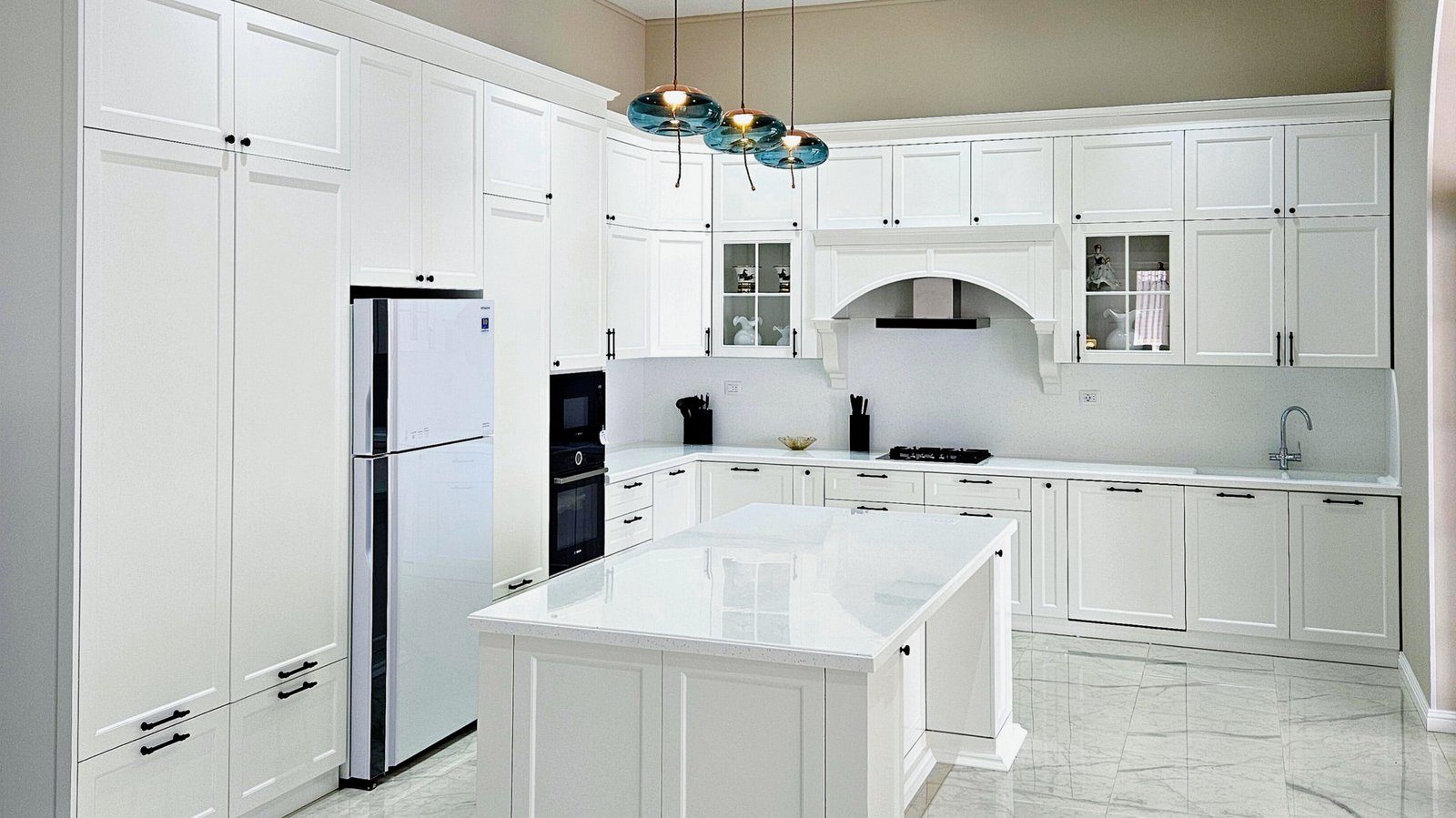
In kitchens and bathrooms, furniture's worst enemy is not direct water but humidity that lingers. Drips from the sink, steam from an opened dishwasher and damp air after a shower gradually soak into any board edge left exposed. One day a swelling appears at the bottom corner of a door, or laminate lifts along a cut. Moisture-resistant boards were developed to reduce that risk, but it is important to understand both what they can do and where their limits lie.
What moisture-resistant board is
Ordinary chipboard and MDF are made by pressing wood particles or fibres with resin. Moisture-resistant versions use additives and a different resin formulation that improve resistance to water. As a result, the board swells less and keeps its shape better in humid air and during short contact with water.
These boards can often be recognised by colour: many manufacturers tint the core of moisture-resistant chipboard and MDF green. The colour is not a standard, though, only a manufacturer's marker; reliable information comes from the board's technical data sheet.
The key point is this: moisture-resistant board is not waterproof. If it stands in water for long or a cut edge is left open, it will still be damaged over time. Its advantage is that it tolerates humidity for longer.
Types: chipboard, MDF, plywood, compact laminate
Moisture-resistant laminated chipboard is the most common choice for kitchen and bathroom carcasses, as it comes with a decorative laminate face and needs no further finish. Moisture-resistant MDF is chosen for painted and routed fronts and shaped details. In both cases, the quality of the final finish, whether laminate, foil or paint, matters as much as the core.
Plywood bonded with water-resistant glue holds screws firmly thanks to its cross-laminated layers and copes well with moisture. Its surface still needs protection with laminate, lacquer or veneer.
Compact laminate is a different material altogether: pressed from many dense layers of decorative laminate with no particle core. It is among the most water-resistant options and is used in bathrooms for shelves, partitions and sometimes under-basin panels. It needs special tools to machine and is heavier than ordinary board.
Where it is really needed
Building an entire kitchen from moisture-resistant board is not always sensible. The risk zones are specific:
- The sink cabinet: base, side panels and back.
- Side panels of units next to the dishwasher, which releases steam when opened.
- Around the fridge and next to an ice maker.
- All bathroom carcasses, especially those close to the shower.
- Cabinets above and beside the washing machine.
In dry zones such as wall cabinets and crockery drawers, good-quality standard laminated board, with properly sealed edges, works for years without trouble.
Edge sealing and installation
The mistake that most undermines moisture-resistant board is an exposed cut. Holes for hinges, the waste trap and water pipes, the rear edge of the base and unfinished corners are exactly where water gets in. All edges should be banded, and the cut surfaces of service holes sealed with silicone or a dedicated sealant.
When installing, a protective aluminium or plastic mat in the sink cabinet is worthwhile: if the trap leaks slightly, water collects on the mat rather than on the board. Fixing a metal steam-protection strip under the worktop above the dishwasher is also common practice. In bathrooms, working ventilation matters as much as the furniture; in a room without an extractor fan, even the best board struggles. Mounting a vanity unit off the floor, wall-hung or on legs, also helps, because water from mopping never reaches the bottom edge of the carcass.
Questions to ask when ordering
Do not settle for a simple "it is moisture-resistant". Ask which units will be made from which board, what type and thickness of edge banding will be used, and how service holes will be protected. Knowing the board manufacturer helps too, since their documentation gives precise material data.
Kitchen and bathroom units from Zaferoglu Mebel are built from Egger and Kronopol board; the measuring visit shows which modules need the moisture-resistant grade, depending on where water pipes and appliances run.