
One abbreviation comes up constantly when furniture is ordered in this region: LDSP, which is laminated chipboard. Most cabinet furniture, from kitchen carcasses to children's wardrobes, office desks and closets, is built from it. Yet people tend either to dismiss it as "cheap particleboard" or to assume it suits every situation equally well. Both views are wrong. Knowing what the material actually is helps you set realistic expectations and ask the right questions when you order.
How it is made
The core of laminated chipboard is particleboard. Wood chips are dried, mixed with synthetic resin and pressed under high temperature. Coarser particles sit in the middle of the board and finer ones near the faces, so the surface is smooth. Decorative paper impregnated with melamine resin is then placed on both faces and bonded in a hot press. The resin melts and cures, and the paper becomes an integral surface of the board.
The resulting material needs no paint or lacquer. The decor paper can imitate wood, stone, concrete or textile, or be a plain colour. Quality production also adds a surface texture, so on a woodgrain board you can feel the direction of the grain with your fingertips.
Thicknesses and uses
The most common thicknesses in furniture are 16 mm and 18 mm, used for carcass sides, shelves and partitions. Thinner boards are sometimes used for drawer bottoms and backs, although backs are more often made from thin fibreboard. Thicker boards are intended for desktops, long shelves and heavily loaded parts.
Thickness is about appearance as well as strength. A thin shelf tends to sag over a long span, while a thick board gives furniture a heavier, more solid look. Designers therefore sometimes use standard board for the carcass and a thicker one for open shelves and tops in the same piece.
Strengths
- The surface resists scratches, knocks and household stains reasonably well and wipes clean with a damp cloth.
- It comes in large, flat, dimensionally stable sheets, so it cuts accurately and machines quickly on industrial equipment.
- The range of decors is very wide, with matching edge banding available.
- In sunlight it holds its colour more steadily than natural wood and some paints.
- It offers a good balance of cost and quality, which is the main reason it is so widespread in made-to-order furniture.
Weaknesses and limitations
The main enemy of laminated chipboard is moisture entering through an exposed cut. The laminated face is waterproof, but a cut edge is bare particleboard and absorbs water. Swollen particleboard does not return to its original shape. Edge banding is therefore an essential part of chipboard furniture, and its quality directly determines how long the furniture lasts.
The second limitation is shape. The board is flat: it cannot be bent or deeply routed with patterns. Shaped fronts and curved forms call for MDF or other materials. The third is screw holding: if the same screw is removed and driven in several times, the particles crumble and the fixing loosens. For furniture that will be taken apart and reassembled often, cam connectors and special dowels solve this.
People also ask about health. The resin in particleboard can release formaldehyde. Emission class E1 is the widely accepted standard for furniture boards, and some manufacturers offer lower-emission boards as well. Sealing every cut edge with banding protects against moisture and further limits emissions.
How to recognise good board
It is hard to test a board at home, but finished furniture reveals a lot. A cut edge without chipped or lifted laminate points to good board and good cutting equipment. There should be no gap, glue line or dark seam between the banding and the board. Looking along the surface at an angle, you should see no waviness. Boards from well-known manufacturers such as Egger and Kronopol come with a clear decor code and technical data, which makes it possible to specify exactly the same material when ordering.
Where to use it and where to consider alternatives
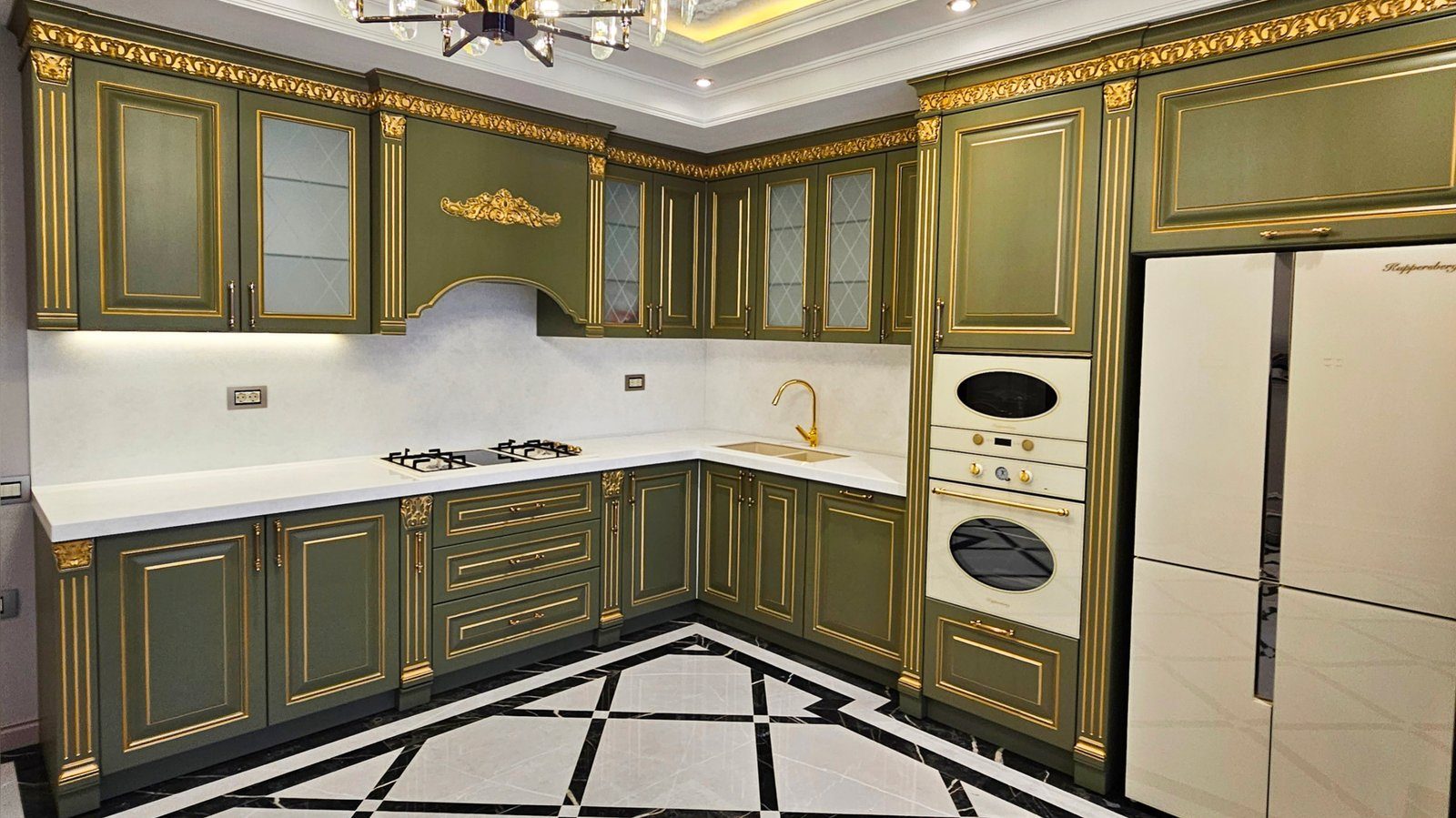
For cabinet furniture in dry rooms, such as wardrobes, bedrooms, children's rooms, offices and living rooms, laminated chipboard is usually the rational choice. It is used in kitchens and bathrooms too, but there edge finishing, protection of sink units and ventilation need more careful planning. For shaped fronts, painted surfaces and non-standard forms, MDF is the better fit.
Zaferoglu Mebel chooses Egger and Kronopol chipboard. The decor and thickness for a particular wardrobe or chest are best chosen once the project dimensions are fixed.