
A shelf full of books starts to sag visibly in the middle after a few months. In another case, the back of a shelf lifts with a careless movement and the dishes on it slide. Both problems usually come from one unanswered question: what will sit on this shelf, and what holds it up? A shelf support is a small part, but the entire load of the shelf rests on it.
What determines the load
Three things govern how a shelf behaves: the thickness and type of board, the distance between supports, and the kind of load. The same board is sturdy over a short span, but sag increases quickly as the span grows. The nature of the load matters too: towels and clothes are light and spread out, while books, crockery, tins and electronics are heavy and concentrated.
Sag does not happen all at once. Particleboard under a constant load gradually creeps, so a shelf that looks straight in the first week may bend a year later. For a bookshelf or a kitchen shelf holding heavy dishes, shortening the span, using thicker board or adding a stiffening strip along the front edge prevents this.
Types of support
- Simple metal pin: fits into a hole in the side panel with the shelf resting on top. Easy to reposition and adequate for light to medium everyday loads. Its weakness is that the shelf can slide or lift.
- Locking support: engages with a slot or screw under the shelf and holds it against movement both down and up. Safer in children's rooms, on open shelving without doors and on upper levels.
- Support with a soft insert: used for glass shelves, it reduces metal-to-glass contact and slipping.
- Hidden bracket: metal rods fixed to the wall that slide into the shelf. The support is invisible and the shelf appears to float. Here the capacity depends heavily on the wall material and the shelf depth.
- Fixed joint: the shelf is connected to the carcass with confirmat screws or cam fittings. It cannot be moved, but it stiffens the carcass, which is very useful in long units.
Getting the positioning right
Support holes must be exactly level. A difference of a millimetre makes the shelf rock, which is why workshops drill them by machine using the same template. Supports should not sit too close to the edge of the board, since the edge is its weakest part. Deep shelves use two supports per side, four points in total, so the shelf does not tip forward.
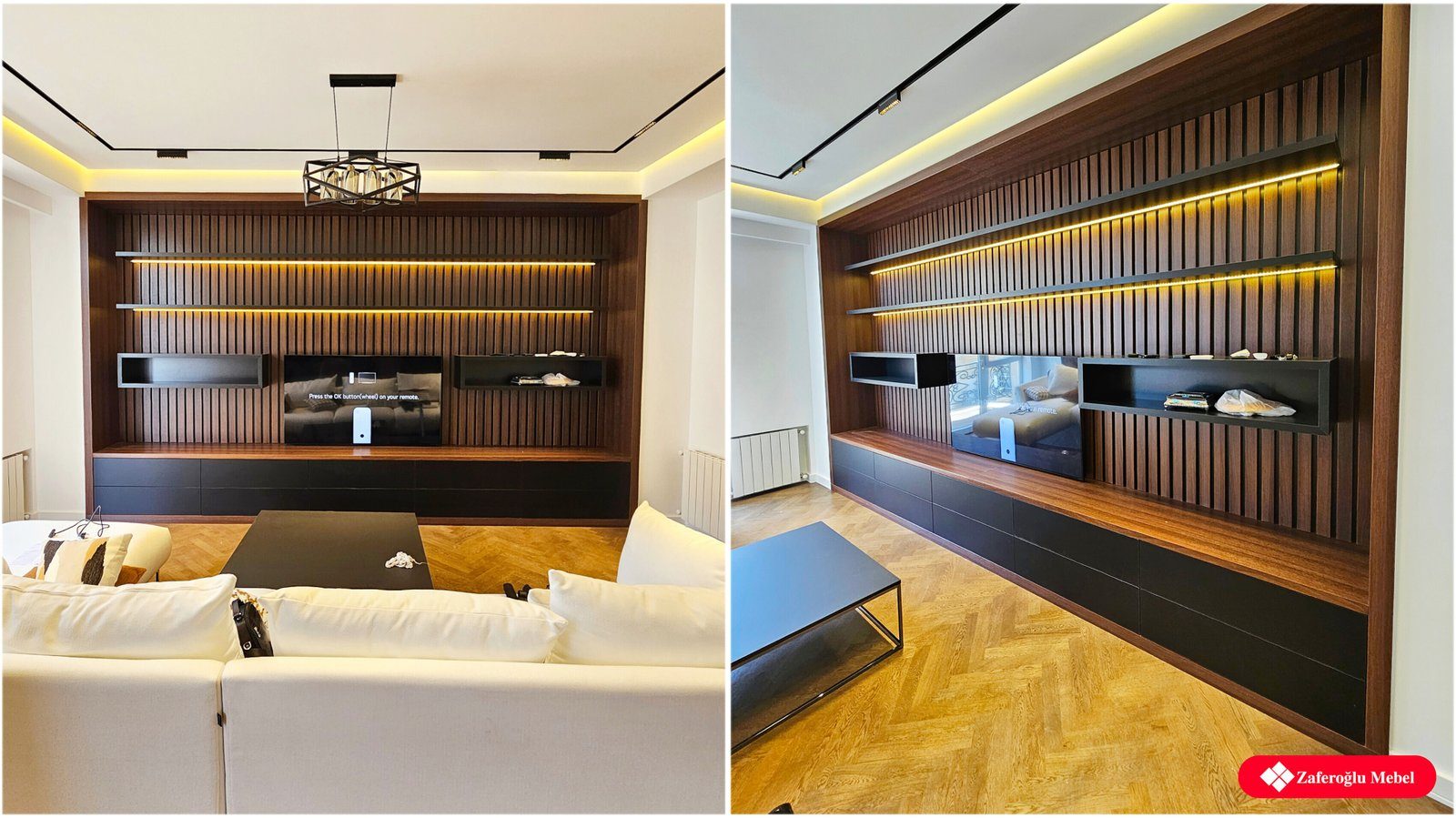
In long cabinets, a vertical divider in the middle halves the shelf span and also stiffens the whole structure. This approach is common in TV units and wall-to-wall shelving systems.
Wall-mounted shelves and the wall itself
On an open wall shelf, the load is carried by the wall fixing rather than the support. Concrete or brick and a plasterboard partition do not hold the same screw in the same way. A heavy shelf on plasterboard needs a metal stud or a timber reinforcement fitted behind it in advance. Cable and pipe routes in the wall should also be checked before drilling.
Special cases: glass and open shelves
A glass shelf behaves differently from a board: it does not bend, but it can break suddenly under excessive weight or a point impact. So glass shelves are kept to short spans, and supports are chosen with soft inserts that stop the glass sliding. If heavy crystal or dinner services will stand on glass shelves in a display cabinet or sideboard, say so in advance so the glass thickness is chosen accordingly.
Open shelves without doors carry another risk: if a shelf is shallow and items sit near its front edge, it can tip forward. Locking supports or an extra fixing at the back keep it in place. Shelving that children might climb should be anchored to the wall as a whole.
A checklist before ordering
- Write down what each shelf will hold: books, dishes, decor, equipment.
- For heavy loads, ask for a short span or an intermediate support.
- On shelves within children's reach, ask for locking supports.
- For glass shelves, confirm the glass thickness and the soft insert in the support.
- For wall shelves, tell the fitter what the wall is made of in advance.
Zaferoğlu Mebel makes TV units, wardrobes and shelving systems to measure. When you say at the design stage what the shelves will carry, the span and support type are chosen for that load.