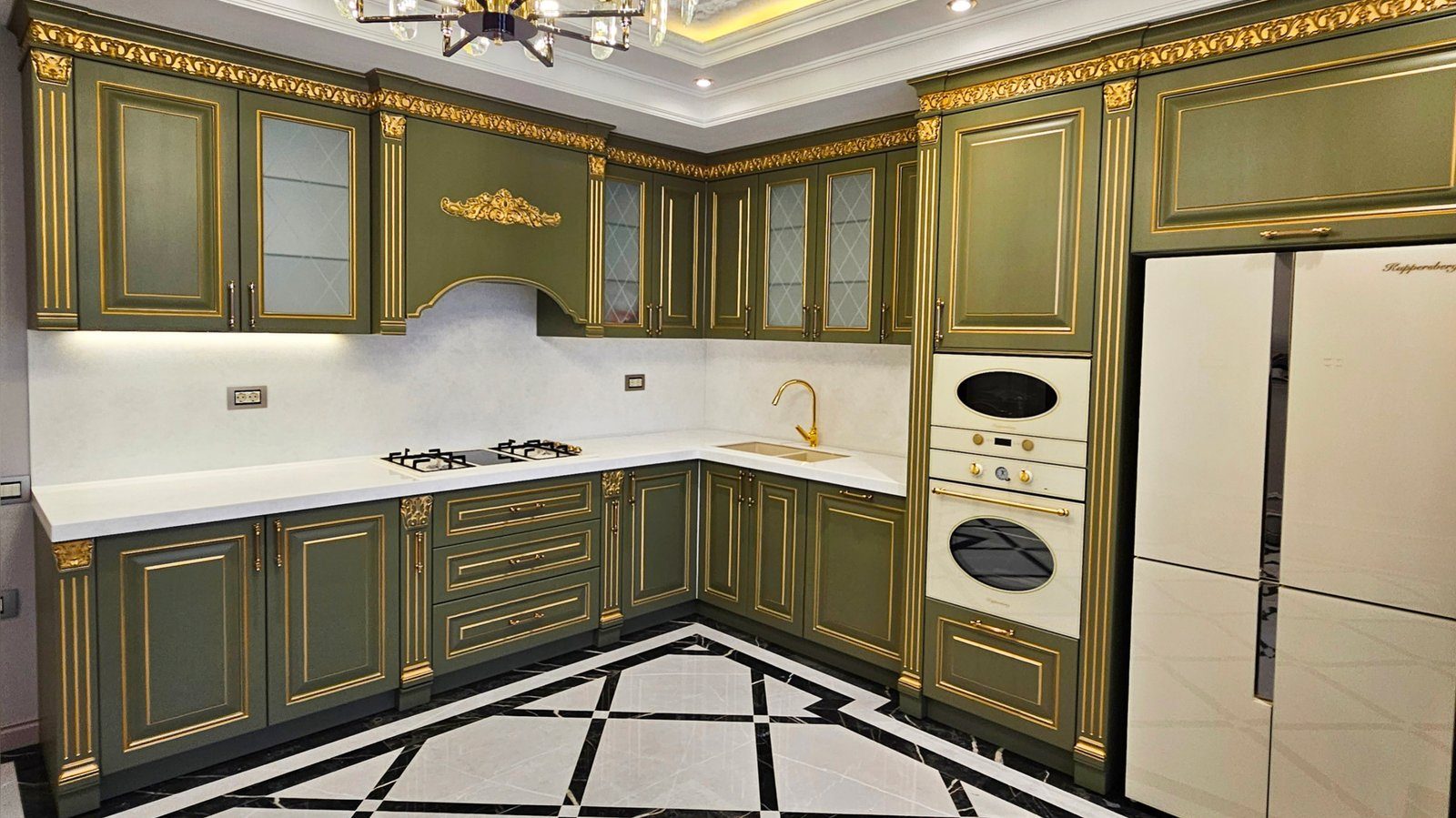

A bulge at the bottom corner of a kitchen cabinet, in the base under the sink or on a bathroom vanity door often seems to appear suddenly. In reality, swelling is the result of a process lasting weeks or months. Particles or fibres inside the board absorb moisture, expand and push the laminate outwards. The process does not reverse: even after drying, the material does not regain its original density. That is why dealing with swelling is mainly about preventing it.
Why swelling happens
The face of laminated board lets through almost no water. The trouble starts at cut edges. When a board is cut to size, its inner structure is exposed, and those edges must be sealed with edge banding. If the banding is poorly bonded, has lifted at a corner or was never applied, water finds a direct route into the board.
The most common sources are:
- A slow leak from the sink trap or a flexible hose.
- Hot steam from an opened dishwasher reaching the underside of the worktop.
- Steam from a kettle or multicooker hitting the base of a wall cabinet.
- Puddles left around plinths and cabinet legs when mopping.
- No ventilation in the bathroom, or a weak extractor.
- Frequently wiping front edges with a wet cloth.
Holes drilled for hinges, traps and pipes also count as cut edges. If their insides are unprotected, that is where water gets in.
Early signs
Spotting swelling early limits the damage. Watch for:
- A slight gap or ripple at the end of the edge banding.
- A rough surface or a bump you can feel along the bottom edge of a door.
- A damp smell or stains on the base of the sink cabinet.
- Doors no longer closing flush, or hinge screws working loose.
- A slight rise in the worktop above the dishwasher.
When you notice any of these, first find the water source. Trying to repair the board without replacing the leaking trap or hose is pointless.
Sometimes the source is further away than it seems. Water leaking from a dishwasher drain hose connection, for instance, can run along the floor under the plinth and cause swelling at the leg of the next unit. In such cases, remove the plinth and look under the cabinets with a torch. The water line to a fridge ice maker is another hidden source. Drying the area and watching it for a few days, with a dry paper towel placed there to see if it gets damp, is a simple way to confirm the leak has stopped.
What to do with a swollen part
In mild cases, where the board is still firm, remove the cause, dry the part fully and re-glue or replace the lifted edge banding. Do not hurry drying with hot air: rapid heating can make the laminate lift further.
If the board has bulged and softened, screws no longer hold or the laminate has cracked, that part, whether base, side panel or door, needs replacing. With made-to-order furniture, this usually means recutting just the damaged piece rather than the whole unit. Knowing the board's decor code makes a matching replacement easier. When replacing a door, record the position of the old hinge holes and the door size.
Prevention: in the workshop and at home
At the production stage, the key steps are moisture-resistant board in wet zones, banding on every cut edge, sealant in service holes, a steam-protection strip above the dishwasher and a protective mat in the sink cabinet.
At home, a few simple habits are enough:
- Do not open the dishwasher the moment the programme ends; let the steam cool a little.
- Do not boil the kettle directly beneath a wall cabinet.
- Once a month, open the sink cabinet and check the trap and hoses.
- Wipe fronts with a well-wrung cloth and do not leave water on edges.
- Keep the bathroom extractor running for a while after a shower.
Zaferoglu Mebel's furniture has a warranty of one to five years. When the kitchen or bathroom is measured, you can go over which spots face the highest risk of swelling.