
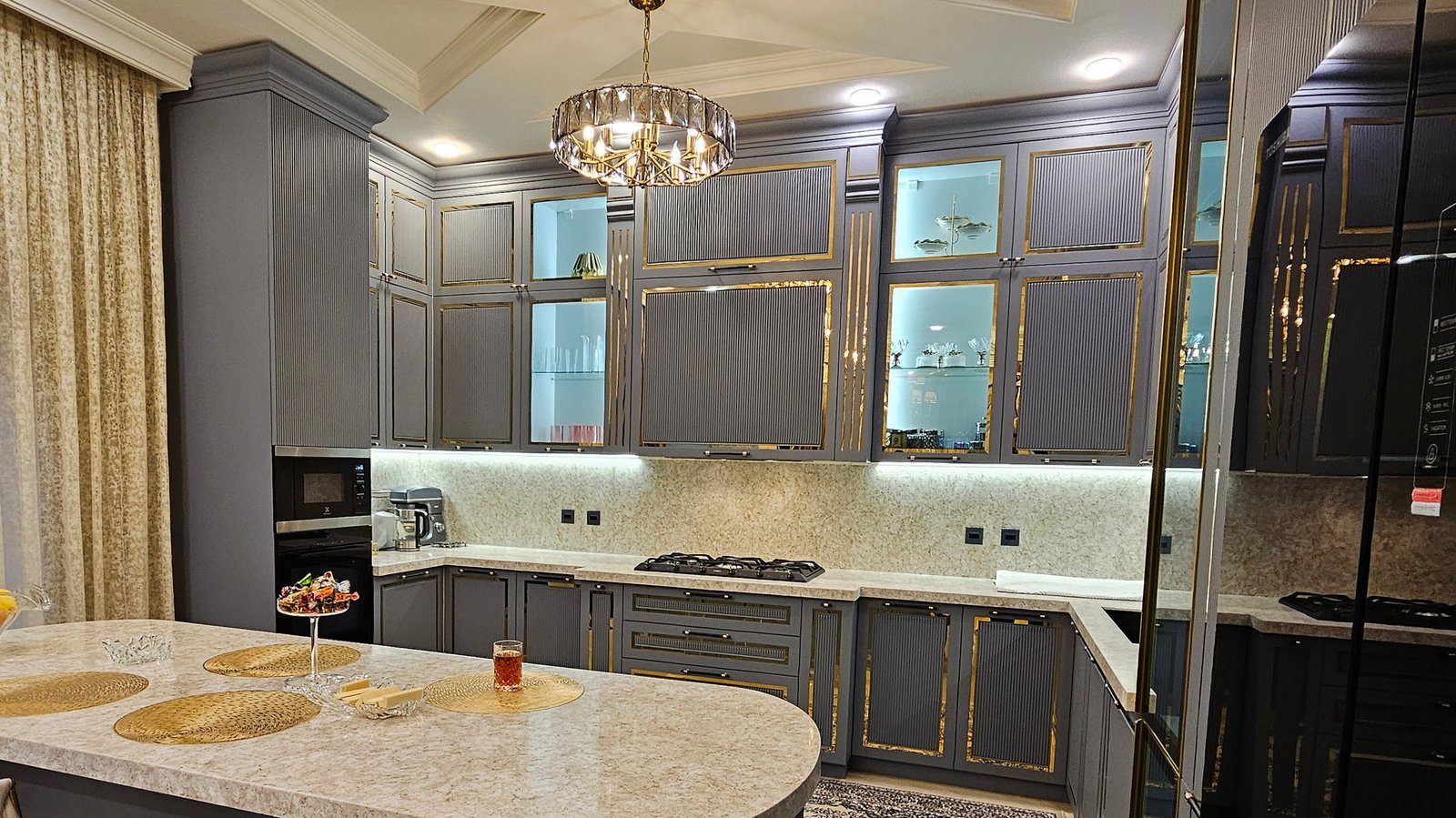
Kitchen units come in standard widths, but a wall's length rarely equals the sum of those widths exactly. The result is a narrow gap beside the hob, next to the fridge or alongside a corner unit. An ordinary shelved cabinet is almost useless in such a space: your hand does not fit and the bottles at the back cannot be seen. Cargo pull-outs and pull-out baskets solve exactly this problem: the entire contents come forward and can be reached from all sides.
What a cargo pull-out is and how it works
A cargo pull-out is a multi-tier basket frame attached to the front. When you pull the front, all the baskets come fully out with it. The difference from an ordinary drawer is that a cargo unit is tall and narrow, and items are taken from the side rather than from above. That makes it ideal for tall but slim items such as bottles, spice jars, oil and vinegar, and cleaning products.
There are several main types of cargo system:
- Base cargo units: next to the hob or preparation area, keeping everyday oils, spices and sauces close at hand.
- Under-sink pull-outs and baskets: for cleaning products, waste bins and the space left around the trap.
- Tall larder pull-outs: a multi-tier frame in a floor-to-ceiling cabinet for dry goods and tins.
- Wall cabinet pull-outs: for spices and small containers at upper level, used less often.
Pull-out baskets and inner drawers
Besides cargo units, pull-out baskets or inner drawers can replace ordinary shelves in wider cabinets too. With a fixed shelf in a base unit, you have to bend down and take out the items in front to reach the pots behind. A pull-out basket brings everything into view.
Another practical solution in a tall cabinet is to place several inner drawers behind one door: from outside you see a single front, while inside each tier pulls out separately. Drawer systems from hardware makers such as Blum offer this as inner drawers with high sides and solid bases.
Wire or solid base
The basket material affects everyday convenience:
- Wire baskets are light, allow air to circulate and show their contents clearly. But small items can fall between the wires, and glass jars can wobble on the rails. Spilt liquid drips into the basket below.
- Solid-base baskets or drawers provide a stable, easy-to-clean surface, and small items do not fall through. An anti-slip mat that can be removed and washed can be laid inside.
- Mixed versions combine a metal frame with a glass or plastic base.
If oils and sauces are going to be stored, a solid, washable base is more practical.
What to check when choosing
- Runner quality and load capacity. A full cargo unit is heavy, so full-extension, soft-close runners are needed.
- Front fixing. A narrow, tall front must not flex when pulled and should sit firmly on the unit with adjustable brackets.
- Tier height. The spacing between baskets should be adjustable to fit the tallest items to be stored.
- Internal cabinet width. The frame and runners take up part of the usable width, and in a narrow cabinet this loss is proportionally noticeable.
- Side rails. Guard rails on the sides of each basket stop items falling out as the unit is pulled.
Common mistakes
A cargo unit is not needed in every gap. The most frequent mistakes are:
- Placing it somewhere rarely used, such as the far side of the fridge. Cargo units are for everyday items and belong near the work area.
- Choosing a very narrow unit and then finding that bottles do not fit. Check the width against what will be stored.
- Loading a tall larder pull-out with tins and jars without regard to its load limit, so the runners strain and the front drops.
- Keeping heat-sensitive items in a pull-out right next to the hob.
Cargo unit or drawer
In a narrow gap a cargo pull-out is the best choice. As width increases, wide drawers and inner drawers often give more usable volume, and their contents are easier to see from above. A balanced kitchen uses both: a slim cargo unit by the hob, wide drawers for pots and pans, and inner drawers or a larder pull-out for food in the tall column.
Zaferoglu Mebel fits Blum mechanisms in its kitchens. Where the narrow gaps fall and which pull-out will serve each one best becomes clear while the run of units is being laid out.