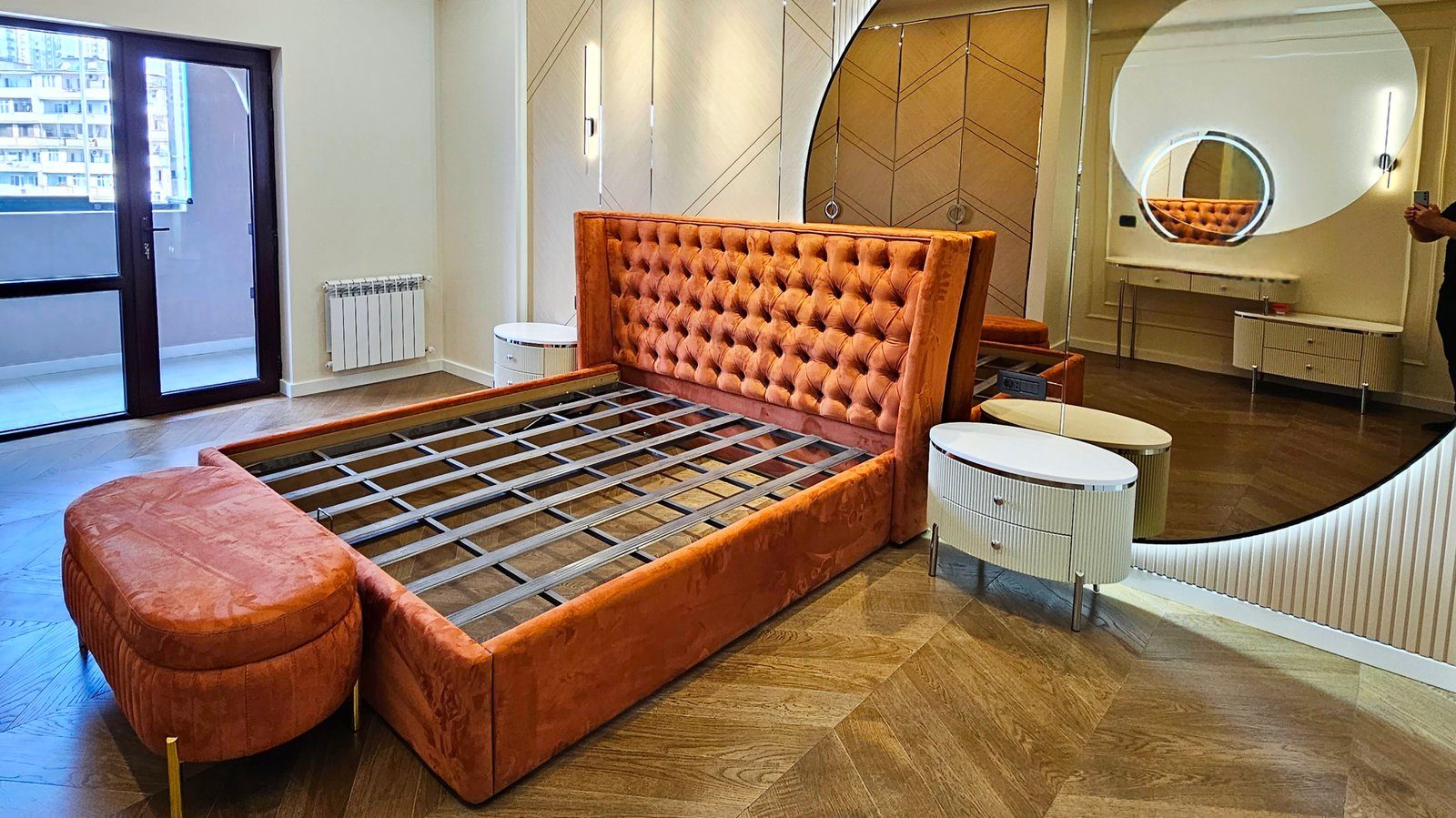

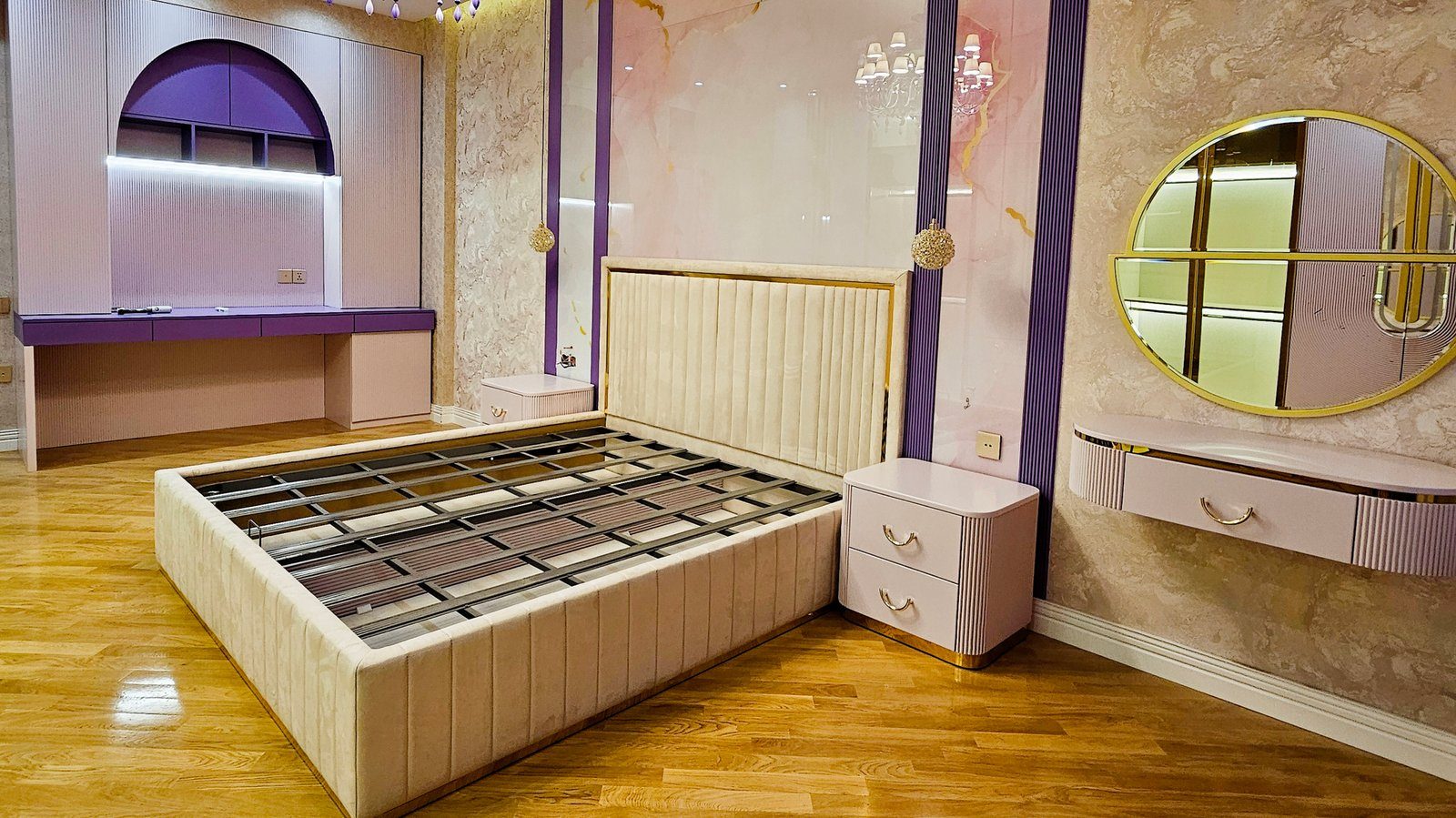
Two mistakes come up again and again when choosing a bed size. The first is buying the biggest bed that fits in the room and leaving no space to move around it. The second is picking a standard size out of habit and then finding that two people keep disturbing each other. The right size lies where three things meet: who sleeps in the bed, how they sleep and how much space the room gives.
Mattress size is not bed size
When people talk about bed size, they usually mean the mattress size, for example 160 × 200 cm. But the frame is larger. Side rails, the headboard and footboard add a few centimetres on each side, and upholstered or wide-framed models add more. When planning a room, use the outside dimensions of the frame, not the mattress.
With made-to-order beds, the mattress size is also decided first, because the inside dimensions of the frame are built around it. If the mattress will be replaced later, staying with a standard size makes finding a new one easier.
Width: one sleeper or two
For single beds, mattresses 80, 90 and 120 cm wide are common. Ninety centimetres is the usual choice for children and teenagers, while 120 cm gives an adult extra comfort in a single bed. Double beds are most often 140, 160 or 180 cm wide, and some manufacturers also offer 200 cm mattresses.
When choosing width for two, look at sleeping habits, not just body size. For couples who toss and turn, sleep with arms spread out, or go to bed and wake at different times, a wider bed directly affects sleep quality. A child who climbs in in the morning or a pet that sleeps on the bed should also be counted. For two adults 140 cm is considered fairly tight; if space allows, 160 or 180 cm is more comfortable.
Length: longer than the tallest sleeper
The standard mattress length is 200 cm, which is enough for most people. The rule is simple: the bed should be roughly 15–20 cm longer than its tallest user, because the body stretches out in sleep and the pillow takes up room. Longer mattresses of 210 and 220 cm exist for very tall people, but the choice of mattresses and bedding in those sizes is narrower.
On beds with a high footboard, a tall person may end up with their feet pressed against it. In that case a model without a footboard or a longer mattress makes sense.
The room: walkways around the bed
When a bed is chosen to fit a room, the main question is how much space is left around it. For comfortable movement, about 60–70 cm of clear space is recommended at the sides and foot of the bed. If there is a wardrobe opposite, more room is needed for its doors or drawers to open. Pushing the bed against a wall saves space, but then one of two sleepers has to climb over the other to get out.
In a small bedroom, it helps to consider the following:
- Going down one size makes moving around the room much easier.
- A bed with a lift-up base turns the space underneath into storage and reduces the need for a separate chest of drawers.
- Shelves built into the headboard save space compared with bedside tables.
- Windows, radiators and the door's opening arc should not be blocked by the bed.
Height is a dimension too
Overall bed height, mattress included, determines how easily you sit down on it and stand up again. Very low platform beds look stylish but can be awkward for older family members. Sitting on the edge, aim to have your knees at about hip height. Remember to add the mattress: swap in a deeper one and the same frame ends up noticeably taller.
Measure before you choose
Draw the room plan on paper or mark the frame dimensions on the floor with masking tape. Open the door, walk up to the wardrobe and pass along both sides of the bed. This simple test tells you more than catalogue figures.
Do not forget the route into the room either. A narrow staircase, a lift or a tight turn in the hallway can stop a large headboard or a one-piece frame from getting through. Made-to-order beds are usually delivered in parts and assembled on site, but one-piece elements such as an upholstered headboard should be checked against door openings. The mattress itself should be carried without bending, which adds difficulty in narrow passages.
At Zaferoglu Mebel, bed width, lift mechanism and headboard shape are settled after the room is properly measured, so the walkways are accounted for from the outset.