
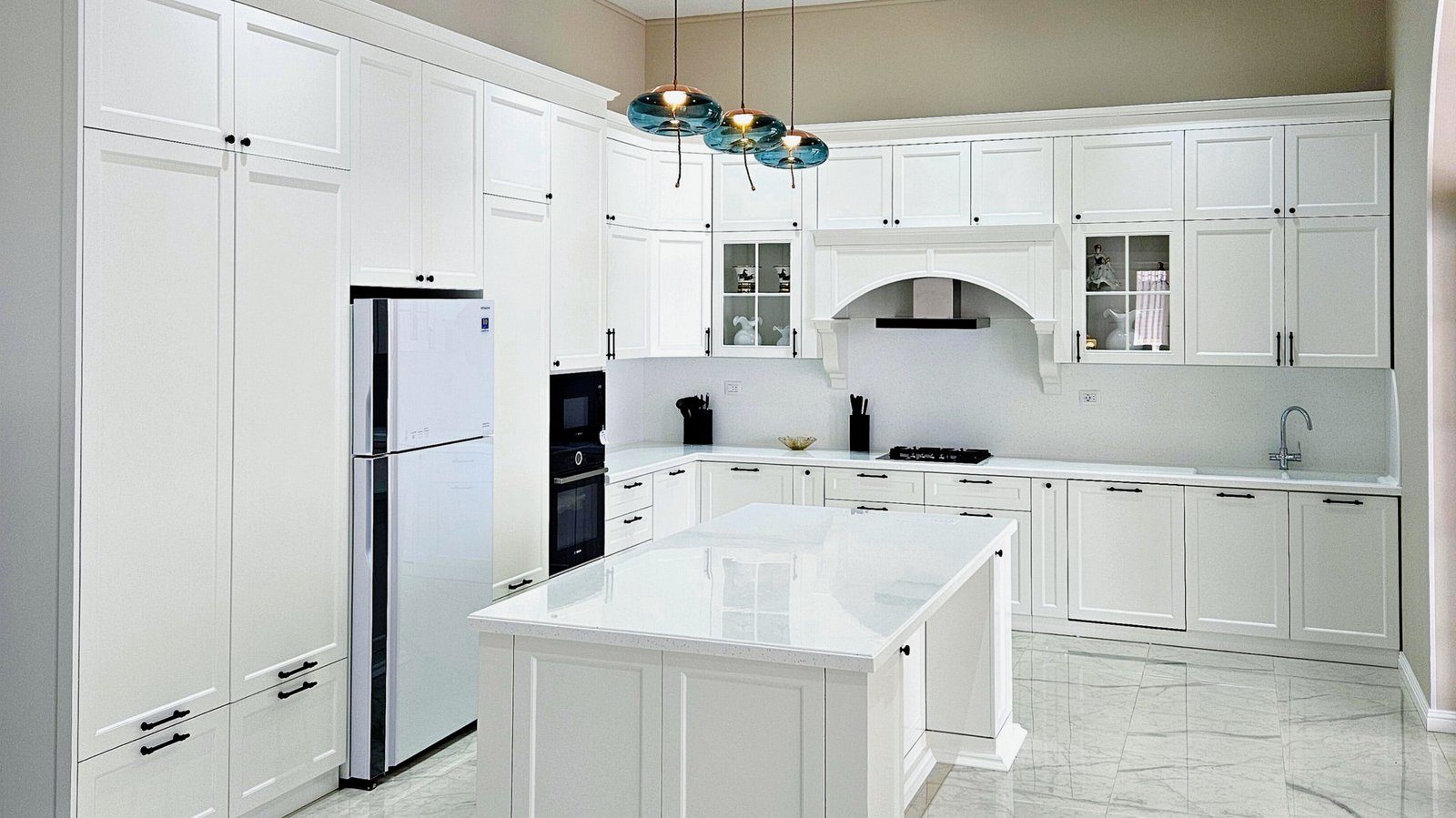
A hinged door is the simplest option for a kitchen wall cabinet, but not always the most convenient in daily use. The corner of an open door can catch your head, with a double cabinet you end up holding doors while taking things out, and an open door blocks your view while working at the counter. Lift-up fronts solve these problems: the flap stays above your head when open and the whole interior is visible. There are, however, several types of lift fitting, each intended for different front sizes and different rooms.
Gas struts and simple flap stays
The simplest solution is to hinge the front at the top and hold it open with a gas strut. It is common in budget furniture and has clear limitations:
- The strut only holds the front fully open; it does not stop in intermediate positions.
- Over time the gas pressure drops, and the flap no longer lifts fully or drifts down on its own.
- Soft closing is not always included, so the front can bang against the carcass.
For small, light fronts, such as a narrow cabinet above the fridge, this is acceptable. For cabinets opened many times a day, more precise fittings are chosen.
Stay lift
In this type the front pivots up around hinges on its top edge, and a lift mechanism mounted on the cabinet sides holds it at any height. In the Blum Aventos range this is known as HK, with a more compact version for small cabinets. A stay lift suits relatively low fronts. Because the flap projects forward when open, on a tall front it can end up at head height.
Parallel lift and up-and-over fronts
With a parallel lift, the front rises straight up while staying vertical and comes to rest above the cabinet. The front never projects forward, but there must be enough space above the cabinet up to the ceiling. On wall units that run to the ceiling this fitting does not work.
With an up-and-over lift, the front moves backwards over the top of the cabinet as it rises. This type suits taller fronts and needs less clearance below the ceiling. In the Blum Aventos range these are HL and HS respectively.
Bi-fold fronts
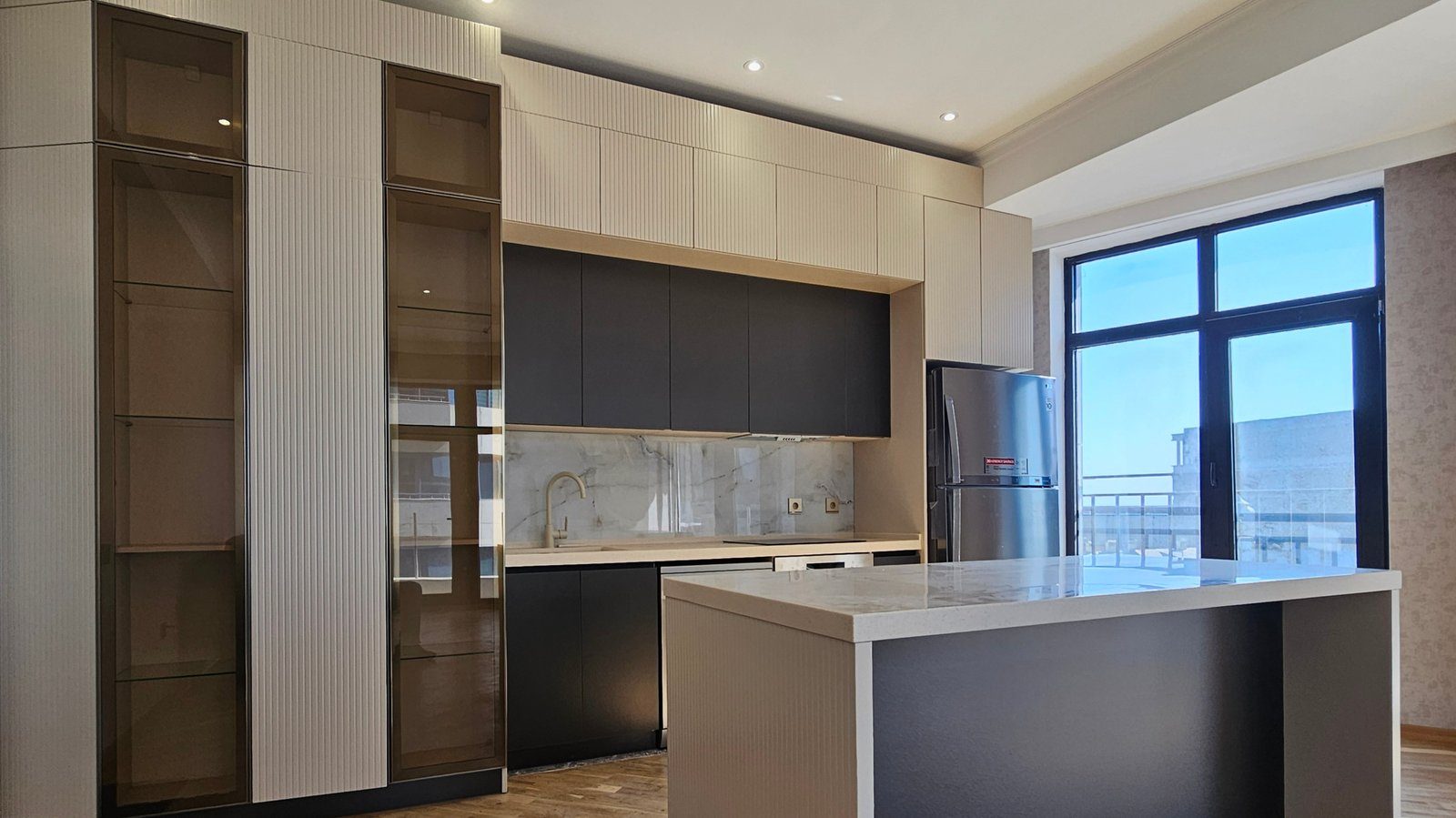
Closing a tall wall cabinet with a single front is not always practical: the open flap rises very high and shorter people cannot reach it. With a bi-fold fitting the front is made in two parts that fold in the middle and gather upwards as it opens. At Blum this is the HF fitting. In kitchens that run up to the ceiling, with no space above the cabinets, a bi-fold front gives the most compact opening. The design of a two-part front needs care: the handle should be on the lower part, or a handleless opening system should be chosen.
What to check when choosing
A lift fitting has to match its front. Manufacturers publish tables for selecting the mechanism by front height and weight. The calculation takes into account:
- Front height and width.
- Material weight: MDF and glass-framed fronts are heavier than laminated ones of the same size.
- The weight and position of the handle.
- Clearance between the cabinet top and the ceiling.
- The mounting height of the cabinet and the height of the people using it.
If the mechanism's force does not match the front, the flap either lifts itself or drops down. Good fittings allow the force to be adjusted after installation, which helps, for example, when a handle is added to the front later.
Electric opening and everyday comfort
In handleless kitchens a front can be fitted with a mechanical touch-to-open system or an electric drive. With an electric system the front lifts and closes on its own in response to a button or a light press on the front. This requires a socket and a cable route, so the decision belongs at the very start of the kitchen design.
After installation, check that the front stops at any intermediate height, closes softly, and does not collide with neighbouring fronts or the ceiling. If a lift fitting is planned above the cooker hood, make sure the extraction duct does not get in the way of the mechanism's movement.
Zaferoglu Mebel fits Blum lift systems in its kitchens; the right mechanism for each wall cabinet is picked once the front dimensions and ceiling height are fixed.